175 Reviews
5.0
★★★★★

T-Bone Accident Liability in Arkansas

Proving Liability in an Arkansas T-Bone Accident

T-bone accidents occur when one vehicle strikes the side of another, often at an intersection where drivers dispute who had the right of way.

These collisions frequently cause severe injuries because the side of a vehicle provides far less protection than the front or rear.

Determining liability usually requires examining traffic signals, stop signs, witness accounts, vehicle damage, and other evidence showing which driver entered the intersection unlawfully.

Arkansas law places a duty on drivers to obey right-of-way rules, traffic signals, and intersection controls, but establishing fault is not always straightforward when both drivers claim they had the legal right to proceed.

Keith Law Group investigates T-bone collisions, preserves critical evidence, and helps injured Arkansas drivers pursue compensation when another motorist’s negligence causes a side-impact crash.

T-Bone Accident Liability in Arkansas

Injured in a T-Bone Car Accident? Contact an Arkansas Car Accident Attorney

T-bone accidents are among the most dangerous types of vehicle collisions because the side of a passenger vehicle provides significantly less protection than the front or rear.

A side-impact crash can cause severe injuries even at relatively moderate speeds, particularly when the force of the collision is concentrated near the driver or passenger compartment.

Many of these crashes occur at intersections where drivers disagree about who had the right of way, whether a traffic signal changed, or whether a vehicle entered the intersection lawfully.

As a result, determining liability often requires more than the statements of the drivers involved. Traffic signal data, witness testimony, vehicle damage patterns, event data recorder information, and intersection camera footage frequently become critical evidence in disputed claims.

Insurance companies often begin investigating these accidents immediately and may look for opportunities to shift a portion of the blame onto the injured driver.

Because Arkansas follows a modified comparative fault system, the amount of compensation available can depend heavily on how fault is assigned.

Understanding how Arkansas law evaluates T-bone accidents can help injured drivers protect their rights and respond effectively when liability becomes contested.

If another driver caused your T-bone car accident, you may be eligible to file a personal injury claim and seek compensation for your injuries.

Contact Keith Law Group today for a free consultation with an experienced Arkansas car accident lawyer.

You can also use the chat feature on this page to find out if you qualify for a T-bone collision claim.

What Is a T-Bone Accident?

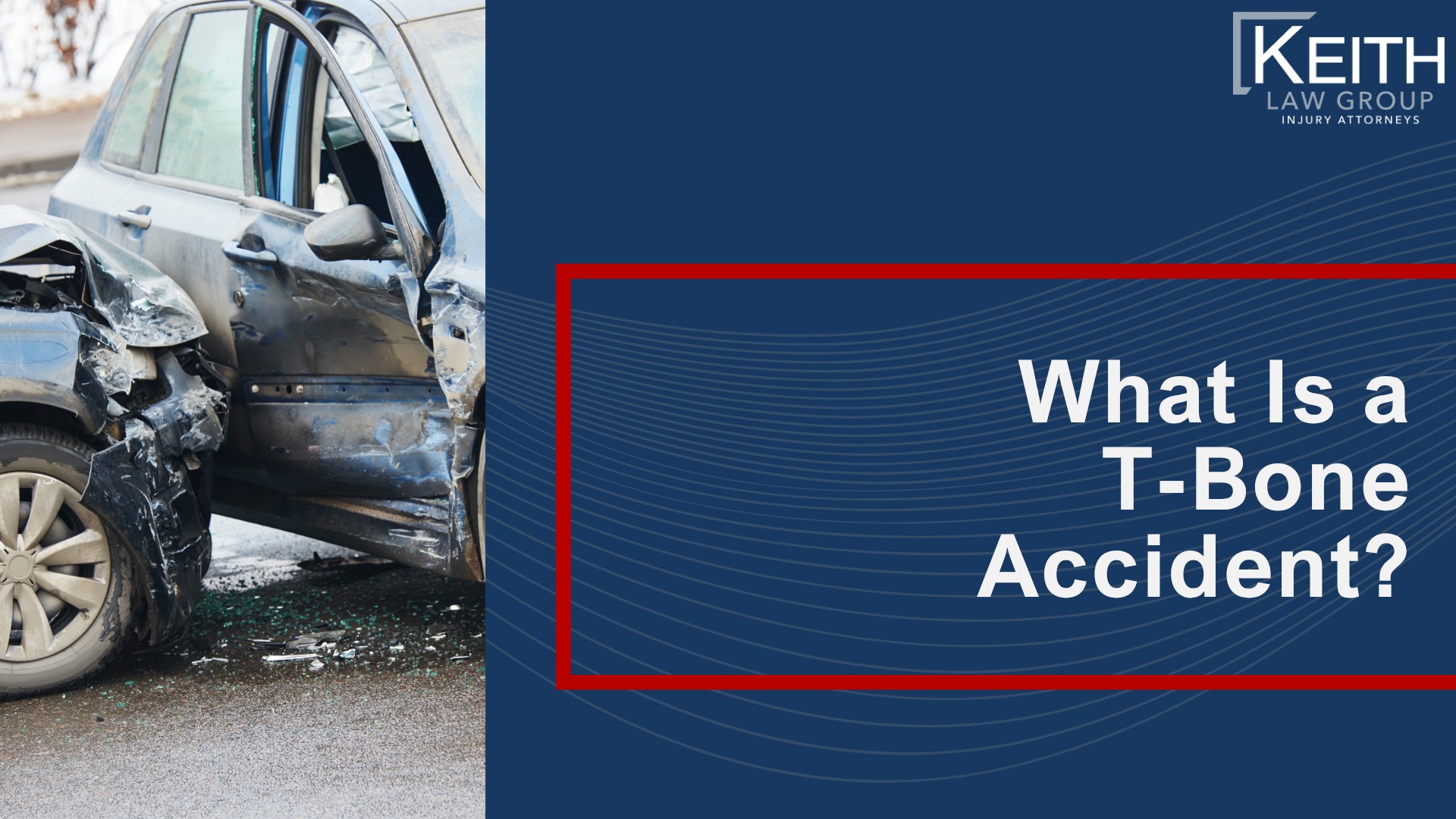
A T-bone accident occurs when the front of one vehicle strikes the side of another at a perpendicular angle. The crash is also called a broadside, side-impact, or angle collision.

The two vehicles form the shape of a “T” at the point of contact.

T-bone accidents often occur at intersections or parking lots. Two paths cross, and one driver enters without the right of way.

The struck vehicle takes the impact on a thin door panel, where side curtain airbags offer less protection than the front and rear crumple zones.

According to the Insurance Institute for Highway Safety, side impact accidents accounted for 22% of passenger-vehicle occupant deaths in 2023, the second most common fatal crash type for vehicle occupants after frontal collisions.

T-bone collisions often result in lifelong disabilities for victims. Impact forces load directly onto the head, chest, and pelvis of the near-side occupant.

A T-bone accident occurs through a single breach of the right of way, and pinning down which driver breached it is the heart of every claim.

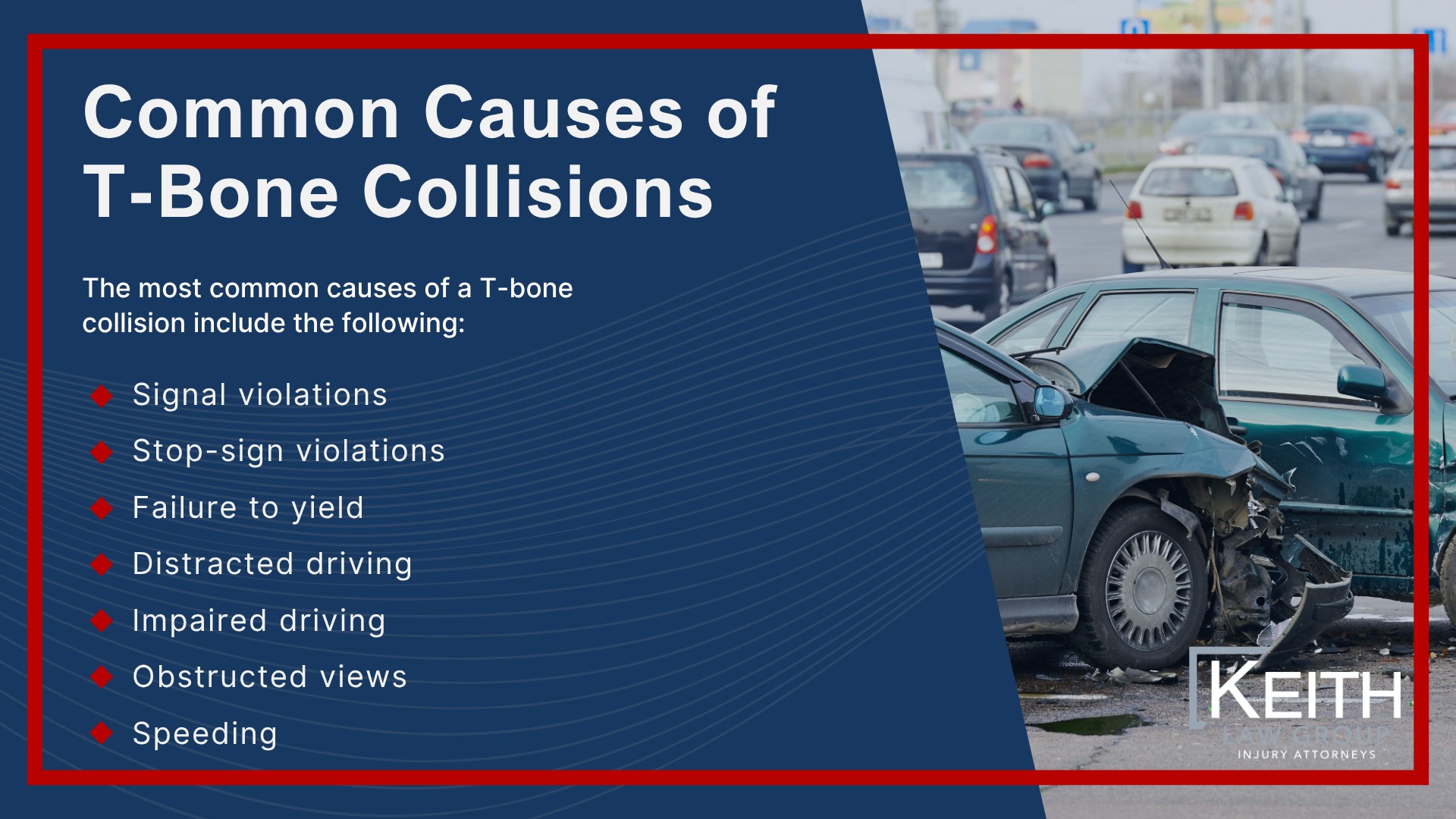
Common Causes of T-Bone Collisions

Most T-bone accidents happen because of driver error at intersections, where one driver entered when traffic law required them to wait.

Almost every cause maps to a specific Arkansas traffic statute, and the broader set of common car accident causes in Arkansas includes the same statutory ground.

The most common causes of a T-bone collision include the following:

  • Signal violations: One of the most dangerous driving behaviors, running red lights is a common cause of T-bone accidents.
  • Stop-sign violations: A driver who rolls through or runs a posted stop sign breaches a clear duty under Arkansas law and enters a path that belonged to cross-traffic.
  • Failure to yield: Drivers failing to yield often cause T-bone accidents. Left turns and uncontrolled intersections see the highest rates, and failures to follow basic traffic rules drive most of them.
  • Distracted driving: Distracted driving can lead to missed stop signs or red lights causing accidents. A glance at a phone is enough to miss a changing signal.
  • Impaired driving: Driving under the influence significantly impairs driving judgment and reaction time. Alcohol-related T-bones spike after midnight.
  • Obstructed views: Obstructed views can lead to T-bone accidents. Parked trucks, foliage, and poor weather conditions all block sight lines into a crossing lane.
  • Speeding: Speeding increases the likelihood of T-bone collisions. A driver who enters above the speed limit loses the time needed to stop for a yellow phase or a cross vehicle.

Parties Who May Be Held Liable for a T-Bone Crash

Liability is not confined to the two drivers involved.

Identifying every responsible party often opens a second or third insurance policy.

Parties who may be held liable include the following:

  • At-fault driver: The driver who ran the signal, failed to yield, or otherwise breached the right-of-way duty, whose personal auto liability coverage usually responds first.
  • Employer or motor carrier: When the responsible driver was working at the time, the employer may share liability for negligent hiring, training, supervision, or vehicle maintenance under respondeat superior.
  • Commercial vehicle owner: A trucking company or fleet owner can be liable separately from the driver, opening commercial policies with much higher limits.
  • Vehicle manufacturer: A brake failure, throttle defect, or airbag malfunction supports a product liability claim against the manufacturer, parallel to the negligence claim against the driver.
  • Government entity: A city, county, or state agency may be liable when a traffic signal malfunctioned or a stop sign was obscured, subject to the Arkansas Tort Claims Act and a shortened notice deadline.
  • Third driver: A driver who never made contact but cut off or forced one of the vehicles can be brought into the claim under joint tortfeasor principles.
  • Vehicle owner: Under negligent entrustment, an owner who lent a vehicle to a driver they knew was unfit may share liability for the resulting harm.

Liability in Common T-Bone Scenarios

Most T-bone claims fall into a handful of recurring fact situations, each presenting a different proof challenge for injury victims.

Physical evidence at the intersection usually decides which driver breached the duty, and the most common situations include the following:

  • Red-light runner: A driver who enters against a steady red strikes a vehicle proceeding on the green, holding primary fault supported by signal-timing logs, the police report, and any citation issued at the scene.
  • Stop-sign violation: A driver who runs the sign and strikes cross-traffic breaches a clear duty under Arkansas law, and the violator is typically liable because cross-traffic had the right of way.
  • Left turn across oncoming traffic: A driver turning left must yield to oncoming vehicles close enough to be an immediate hazard, and failure to yield places the turning driver at primary fault unless the other vehicle was speeding or running a red light.
  • Uncontrolled intersection: Where neither road has a stop or yield sign, Arkansas law requires the driver on the left to yield to the driver on the right when both arrive at the same time.
  • Disputed green light: When each driver claims a green, fault is decided by signal-timing logs, EDR downloads, intersection cameras, and accounts of perpendicular witnesses.
  • Commercial vehicle T-bone: A trucker, delivery driver, or rideshare driver who T-bones a passenger vehicle while on the clock opens the commercial policy of the employer alongside the personal policy of the driver, which often produces a much larger recovery.

Evidence Used to Prove Liability in a T-Bone Claim

Physical evidence at the intersection usually decides a contested T-bone, and determining liability starts with the damage on the vehicles involved.

Each category of proof addresses a different part of determining liability:

  • Signal timing logs: Municipal traffic departments record signal phases by the millisecond, and a subpoena obtains the phase data for the seconds before the crash, which settles disputed-green cases.
  • Intersection cameras: Many busy Arkansas intersections have traffic cameras that capture the approach, the entry, and the contact, which helps establish fault in disputed cases.
  • Vehicle damage angle: The point of impact on the struck vehicle and the front-end damage on the striking vehicle place the angle of contact and the path each car was traveling.
  • Event data recorder: A modern vehicle black box records speed, brake application, and steering input from the seconds before the crash.
  • Police report: The diagram from the officer, the citations issued, and the statements taken at the scene form the first official record needed to establish fault.
  • Witness statements: A witness positioned perpendicular to the two approaches saw both signals and both vehicles, which makes their account stronger than the account of either driver, and witness statements often decide red light disputes.

Preserving this proof depends on acting fast, since signal data is often overwritten in days and camera footage in weeks.

Common Injuries in a T-Bone Crash

T-bone accident injuries are often more severe than those seen in many other types of car accidents because the occupants sit only a short distance from the point of impact.

Unlike frontal collisions, where crumple zones absorb a significant portion of the force, side-impact crashes transfer energy directly into the passenger compartment.

Car accident victims may strike the door, window, seatbelt, center console, or steering wheel during the collision, creating a high risk of catastrophic injuries.

Many of these injuries require extensive medical treatment, rehabilitation, surgery, or long-term care.

Some injuries are obvious at the scene, while others are not immediately apparent and may take hours or days to fully develop, making immediate medical attention critical after a serious side-impact crash.

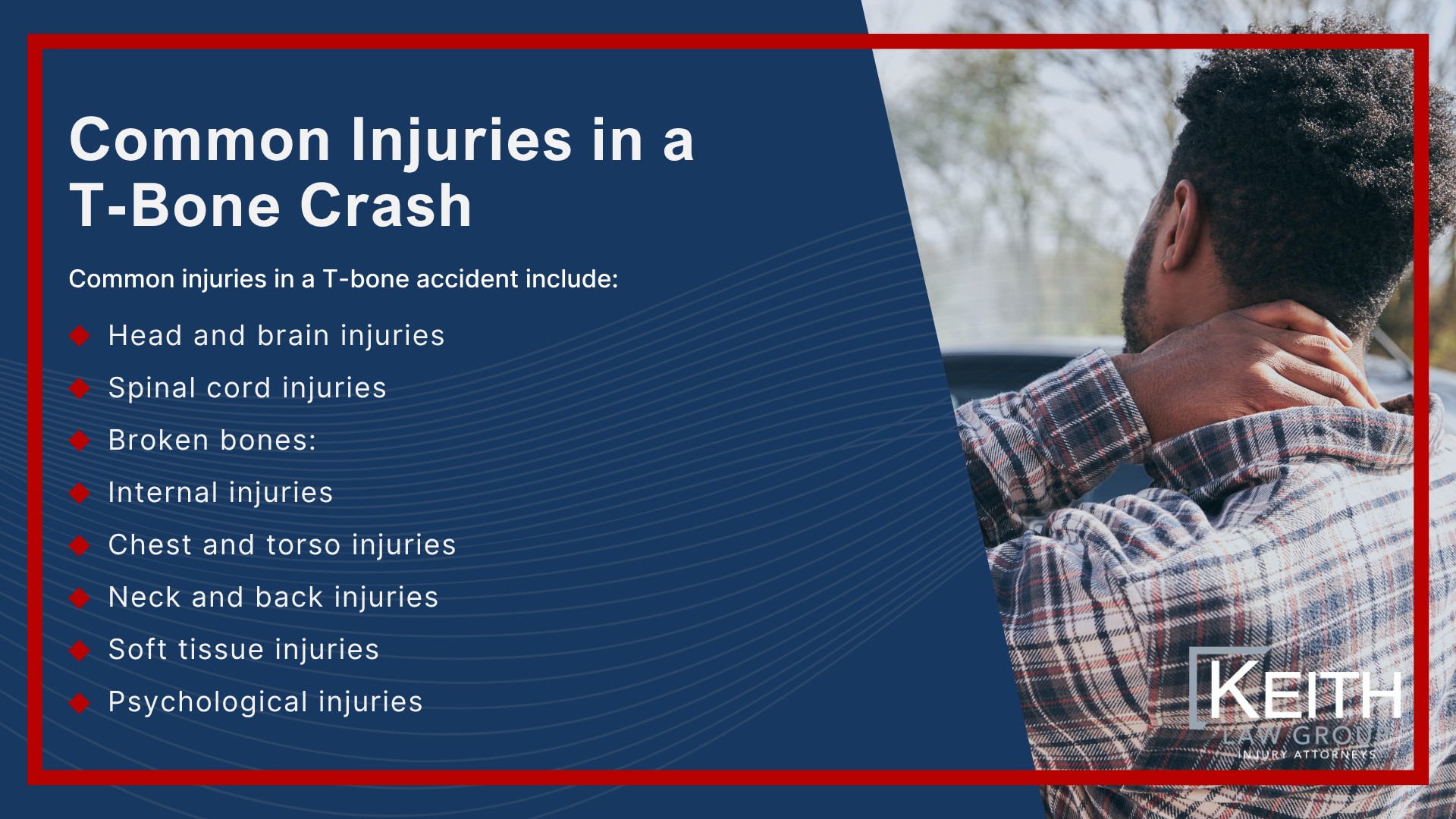
Common injuries in a T-bone accident include:

  • Head and brain injuries: Side-impact crashes frequently cause head and brain injuries when an occupant’s head strikes the window, door frame, steering wheel, or another interior surface. These injuries range from concussions to severe traumatic brain injuries that affect memory, concentration, balance, speech, and cognitive function.
  • Spinal cord injuries: The twisting and lateral forces involved in a T-bone collision can damage the spinal cord, vertebrae, discs, and surrounding nerves. Severe spinal cord injuries may result in chronic pain, loss of mobility, paralysis, or permanent disability.
  • Broken bones: The side of the body nearest the impact often absorbs the greatest force. Broken ribs, fractured arms, legs, collarbones, hips, and pelvic fractures are common in serious side-impact collisions.
  • Internal injuries: Damage to internal organs may occur when the body is compressed against the door, seatbelt, or other vehicle structures. Internal injuries involving the lungs, liver, spleen, kidneys, or other organs may not be immediately apparent but can become life-threatening without prompt treatment.
  • Chest and torso injuries: Side impacts frequently cause rib fractures, lung injuries, bruising, and trauma to the chest cavity. These injuries may require hospitalization and extensive follow-up care.
  • Neck and back injuries: Whiplash, herniated discs, nerve damage, and other spinal injuries can develop even when vehicle damage appears moderate.
  • Soft tissue injuries: Damage to muscles, ligaments, tendons, and connective tissue may result in pain, stiffness, reduced range of motion, and prolonged recovery periods.
  • Psychological injuries: Anxiety, depression, sleep disturbances, and post-traumatic stress symptoms may develop after a violent collision, particularly when the crash results in severe injuries or permanent impairments.

Visible injuries such as cuts, bruises, and fractures often receive immediate attention, but some of the most serious conditions are hidden beneath the surface.

Car accident victims should seek immediate medical attention after a T-bone collision, even if they initially feel well, because prompt evaluation can identify injuries before they become more severe and create an important record connecting the injuries to the crash.

Damages You Can Recover in a T-Bone Collision

A T-bone claim includes economic and non-economic damages, plus punitive damages in rare cases.

These Arkansas compensation types run from emergency treatment and lost wages to future medical care and the permanent impairment a serious side impact leaves behind.

Economic Damages

Economic damages compensate T-bone accident victims for the financial losses caused by the collision.

Unlike pain and suffering or emotional distress, these damages can usually be documented through bills, invoices, employment records, tax returns, repair estimates, and other objective evidence.

A serious side-impact crash can generate substantial expenses within days of the accident and continue creating financial burdens for years afterward.

Victims with traumatic brain injuries, spinal cord injuries, multiple fractures, or other catastrophic injuries often require extensive medical treatment, rehabilitation, assistive devices, and long-term care.

Economic damages are intended to place the injured person in the financial position they would have occupied had the collision never occurred.

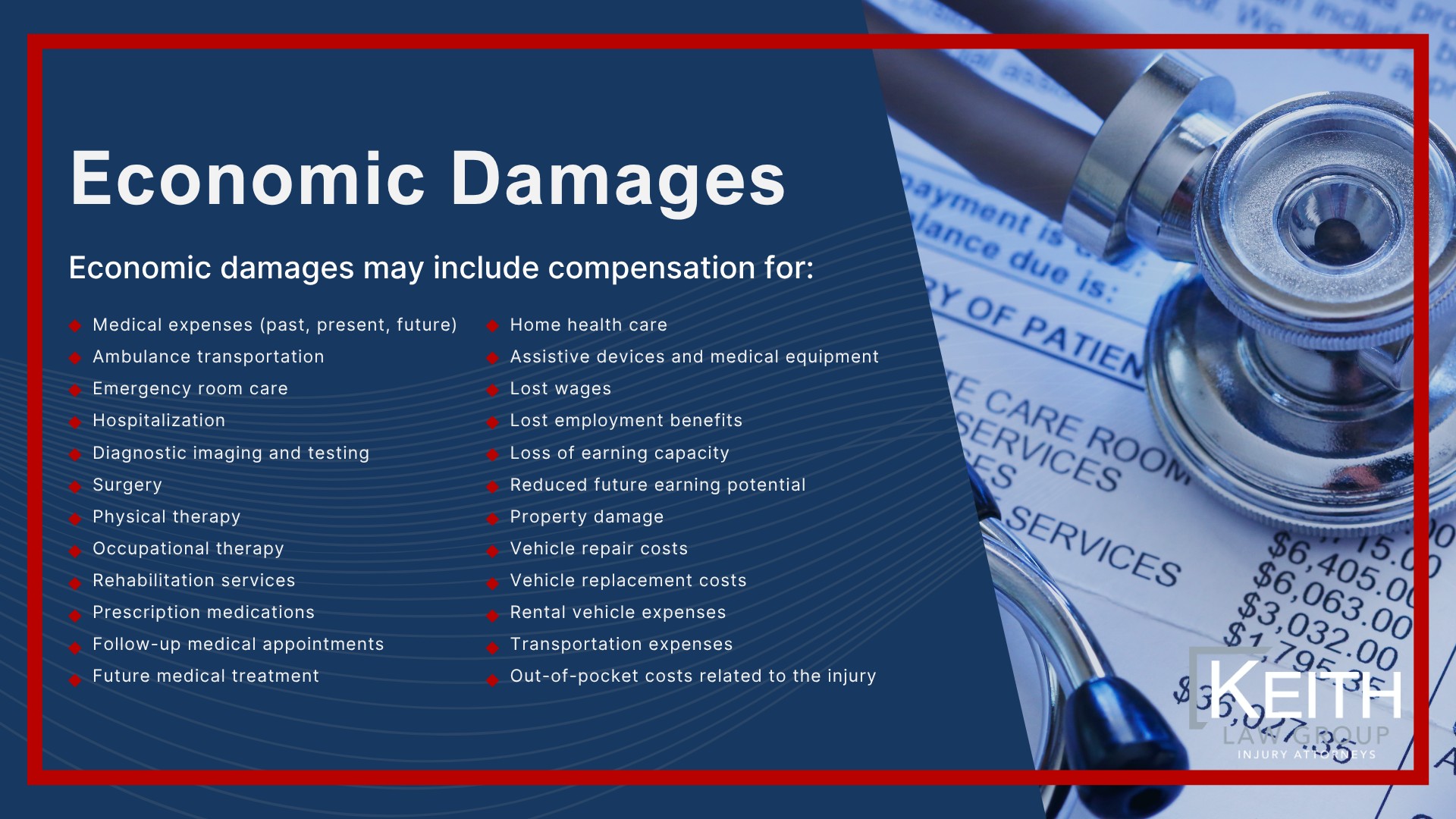
Economic damages may include compensation for:

  • Medical expenses (past, present, future)
  • Ambulance transportation
  • Emergency room care
  • Hospitalization
  • Diagnostic imaging and testing
  • Surgery
  • Physical therapy
  • Occupational therapy
  • Rehabilitation services
  • Prescription medications
  • Follow-up medical appointments
  • Future medical treatment
  • Home health care
  • Assistive devices and medical equipment
  • Lost wages
  • Lost employment benefits
  • Loss of earning capacity
  • Reduced future earning potential
  • Property damage
  • Vehicle repair costs
  • Vehicle replacement costs
  • Rental vehicle expenses
  • Transportation expenses
  • Out-of-pocket costs related to the injury

Arkansas law generally allows injured victims to recover the reasonable value of financial losses caused by another driver’s negligence.

In severe cases, future damages may represent a substantial portion of the claim because the effects of the injuries continue long after the initial recovery period.

Physicians, vocational experts, economists, and life-care planners may be used to estimate the future costs associated with ongoing treatment, permanent disabilities, and diminished earning capacity.

Careful documentation of every financial loss helps establish the full value of the claim and supports recovery for both current and future expenses.

Non-Economic Damages

Not every loss caused by a T-bone accident can be measured through medical bills, lost wages, or repair estimates.

Arkansas law allows injured victims to pursue compensation for the physical pain, emotional harm, and personal limitations that often follow a serious side-impact collision.

These damages recognize that a catastrophic injury affects far more than a person’s finances.

A victim may struggle with chronic pain, reduced mobility, loss of independence, psychological trauma, or the inability to participate in activities that were once part of everyday life.

In severe cases, the effects of a T-bone crash can alter family relationships, career opportunities, and long-term quality of life for years after the collision.

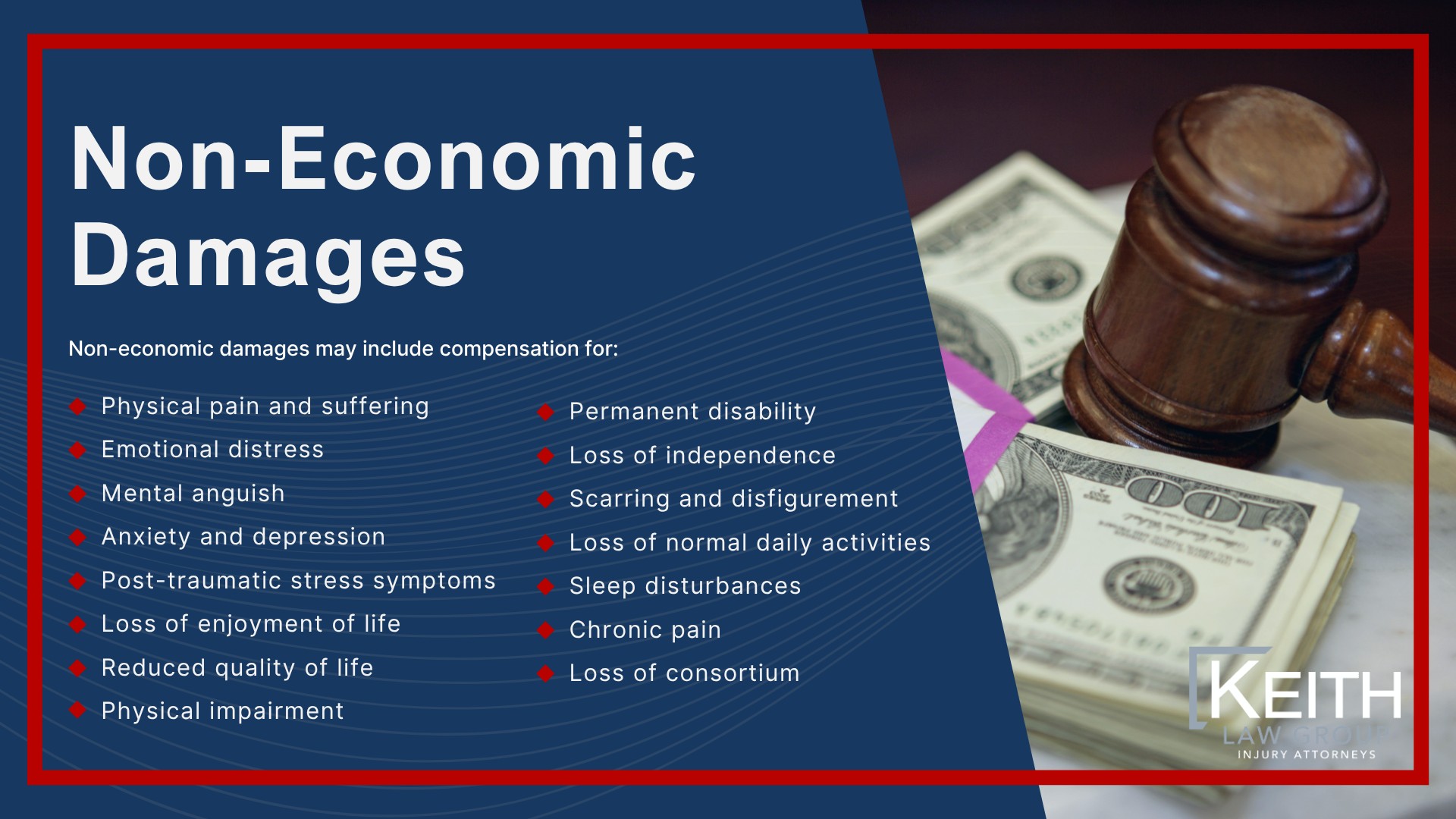
Non-economic damages may include compensation for:

  • Physical pain and suffering
  • Emotional distress
  • Mental anguish
  • Anxiety and depression
  • Post-traumatic stress symptoms
  • Loss of enjoyment of life
  • Reduced quality of life
  • Physical impairment
  • Permanent disability
  • Loss of independence
  • Scarring and disfigurement
  • Loss of normal daily activities
  • Sleep disturbances
  • Chronic pain
  • Loss of consortium

The value of non-economic damages often depends on the severity of the injuries and the extent to which they affect a person’s daily life.

A victim who makes a full recovery may experience a very different level of loss than someone living with permanent spinal cord injuries, traumatic brain injuries, chronic pain, or lifelong physical limitations.

Medical records, physician opinions, testimony from family members, photographs, rehabilitation records, and evidence showing changes in daily activities can all help demonstrate the full impact of the injuries.

Although these losses do not come with receipts or invoices, they are often among the most significant damages suffered by T-bone accident victims.

Punitive Damages

Arkansas allows punitive damages only on clear and convincing evidence that the negligent driver knew the conduct would likely cause harm and continued with malice or reckless disregard.

A drunk-driving T-bone or a deliberate red-light run can meet that bar, though an ordinary signal mistake will not.

Wrongful Death Damages

A fatal T-bone gives rise to a claim under the Arkansas wrongful death statute.

The claim recovers funeral expenses, the lost income and support the deceased would have provided, and the mental anguish suffered by the statutory beneficiaries.
Insurance Disputes Over T-Bone Liability

Insurance companies begin their fault review within days of the crash, and a two-moving-car T-bone gives the adjuster more openings than a rear-end claim.

Insurance companies aim to minimize payouts after accidents.

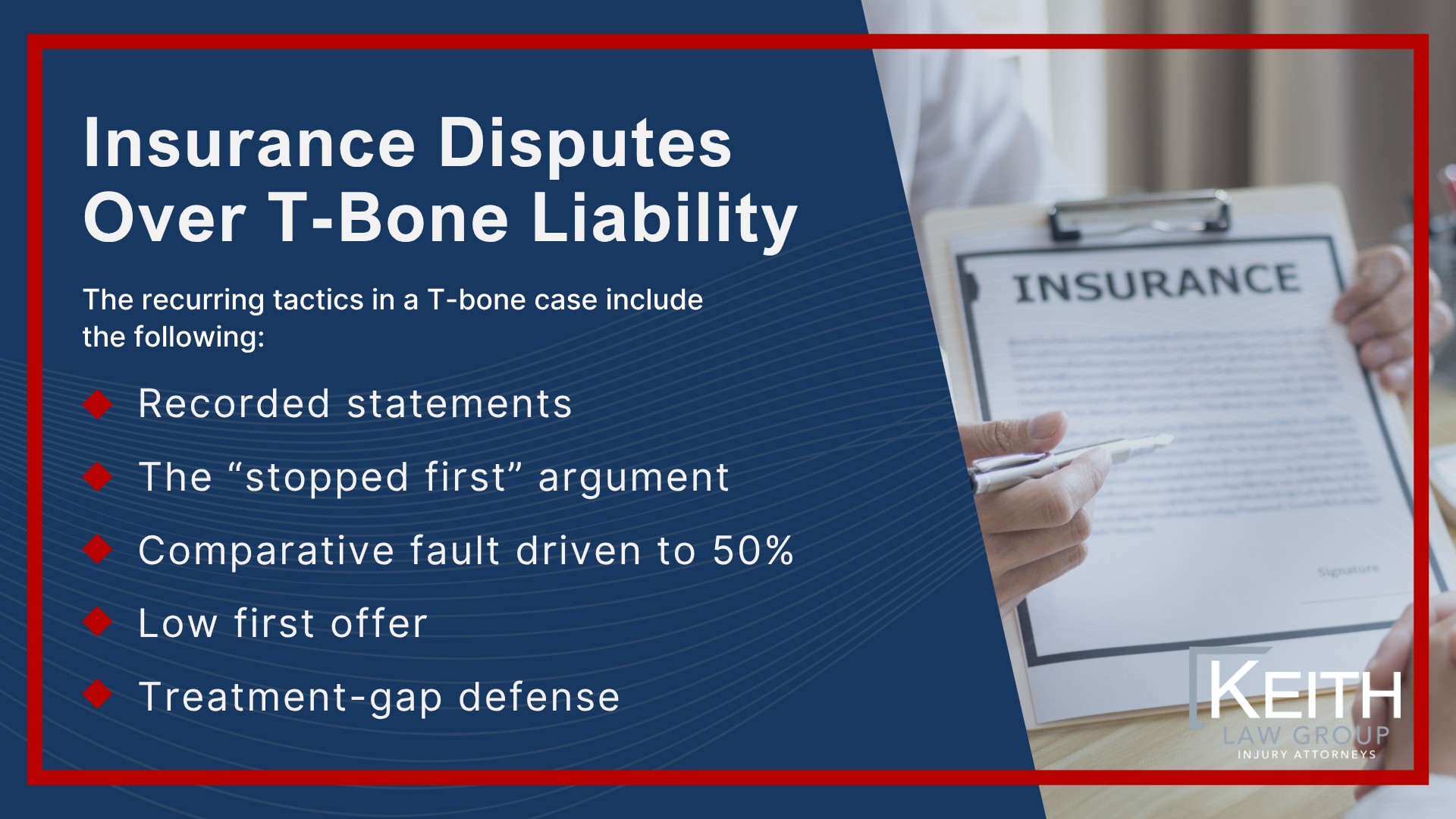
The recurring tactics in a T-bone case include the following:

  • Recorded statements: An adjuster asks for one early, then reads it against the police report for any phrasing about speed or signal timing that becomes an admission, so injured drivers should not admit fault during these calls, and should avoid admitting fault to anyone at the scene.
  • The “stopped first” argument: At a four-way stop with no signal data, the adjuster argues for shared fault on the theory that neither driver can prove they arrived first.
  • Comparative fault driven to 50%: A single percentage point past 49 ends the claim, so a contested signal becomes an opening to push the injured driver to or past that line.
  • Low first offer: Insurance companies open with a number that rests on a fault percentage already inflated against the injured driver, and it rarely reflects fair compensation for the actual loss.
  • Treatment-gap defense: A delay before the first medical visit becomes the argument that the injury came from something other than the T-bone, so the carrier reviews early medical records for any gap they can exploit.

Each is answered with documentation, and the Arkansas car accident settlement process follows a predictable flow that responds to each tactic.

Statute of Limitations for T-Bone Claims in Arkansas

Arkansas gives an injured driver 3 years from the date of the crash to file a personal injury lawsuit, and the same statute of limitations applies to property damage. A delayed-onset spine or head injury does not reset the clock.

A fatal T-bone carries its own 3-year deadline measured from the date of death.

A crash involving a city, county, or state vehicle runs on a shorter and separate notice deadline that often expires within months.

Arkansas also requires a written SR-1 report to the Department of Finance and Administration within 30 days of any crash causing injury, death, or property damage above $1,000.

Speak With an Arkansas Car Accident Attorney

T-bone accidents often leave victims facing some of the most severe consequences seen in motor vehicle collisions.

Serious injuries, lengthy medical treatment, lost income, permanent disabilities, and disputes over fault can quickly turn a side-impact crash into a life-changing event.

At the same time, insurance companies frequently investigate these claims aggressively, particularly when questions arise about traffic signals, right-of-way violations, or comparative fault.

Building a strong claim requires prompt preservation of evidence and a thorough understanding of Arkansas law.

Keith Law Group represents Arkansas drivers and passengers injured in side-impact collisions and works to recover compensation for the full extent of their losses.

Our firm investigates the crash, secures critical evidence, identifies all potentially liable parties, and pursues damages for medical expenses, lost wages, pain and suffering, property damage, and future losses when warranted.

Whether the collision involved a red-light violation, a failure to yield, a disputed green light, or a commercial vehicle, Keith Law Group can evaluate the facts and explain the legal options available.

If you or a loved one suffered serious injuries in a T-bone accident caused by another driver’s negligence, you may be entitled to recover compensation under Arkansas law.

Contact Keith Law Group today for a free consultation with an experienced Arkansas car accident lawyer.

Call (501) 356-4180 or use the chat feature on this page to discuss your case and learn whether you may have a claim.

Frequently Asked Questions

Published by:
Share

This article has been written and reviewed for legal accuracy and clarity by the team of writers and attorneys at Keith Law Group and is as accurate as possible. This content should not be taken as legal advice from an attorney. If you would like to learn more about our owner and experienced injury lawyer, Sean T. Keith, you can do so here.

Keith Law Group does everything possible to make sure the information in this article is up to date and accurate. If you need specific legal advice about your case, contact us. This article should not be taken as advice from an attorney.

Other Car Accident Lawsuit Resources
All
FAQs
Injuries & Conditions
Legal Help
Other Resources
Settlements & Compensation
You can learn more about other Car Accident Lawsuit resources below:
15 Common Car Accident Causes in Arkansas & Prevention Tips
Arkansas Auto Accidents: How to File a Car Insurance Claim
Arkansas Car Accident Compensation Types & Laws to Know
Arkansas Car Accident Injury Claim Process
Arkansas Car Accident Lawsuit Guide: Tips for Success
Arkansas DUI Accident Lawsuits: Laws, Damages, & Safety Tips
Arkansas Hit and Run Accident Guide: Laws & Tips to Know
Average Arkansas Car Accident Settlements & Tips to Maximize Yours
Car Accident Damages in Arkansas: Potential Compensation
Car Accident Reporting in Arkansas
Car Accident Statute of Limitations Arkansas
Common Types of Accidents in Arkansas
Finding the Best Car Accident Attorney in Arkansas for Your Case
Hit and Run Car Accident Lawsuits in Arkansas
How Is Fault Determined in Arkansas Auto Wrecks?
How Much Can Someone Sue for a Car Accident in Arkansas
How Much Does a Car Accident Lawyer Cost to Hire in Arkansas?
How to File a Police Report After a Car Accident in Arkansas
How to File an Auto Accident Lawsuit in Arkansas
How to Get a Police Report After a Car Accident in Arkansas
Liability in Multi-Vehicle Accidents in Arkansas
Rear-End Accident Liability in Arkansas
Should I Get a Lawyer for a Car Accident?
Sideswipe Accident Liability in Arkansas
Statute of Limitations: Car Accident Claims in Arkansas
Steps to Take After a Car Accident in Arkansas
T-Bone Car Accident Lawsuits in Arkansas: Things to Know
Types of Evidence in Arkansas Car Accident Cases
Understanding Car Accident Insurance Claims in Arkansas
Understanding the Arkansas Car Accident Settlement Process
Who Pays for My Medical Bills After a Car Accident in Arkansas

Other Car Accident Lawsuit Resources

All
FAQs
Legal Help
Other Resources
Settlements & Compensation