175 Reviews
5.0
★★★★★

Rear-End Accident Liability in Arkansas

Proving Liability in an Arkansas Rear-End Accident

Rear-end accident liability in Arkansas often centers on whether the following driver left enough time and distance to avoid a collision.

While the driver who strikes the vehicle ahead is frequently found at fault, Arkansas law requires insurers, judges, and juries to evaluate the specific facts of each crash before assigning responsibility.

Questions involving following distance, distracted driving, speeding, sudden stops, brake lights, and comparative fault can all affect the outcome of a claim.

Keith Law Group investigates rear-end collisions, preserves key evidence, and helps injured drivers pursue compensation when another motorist’s negligence causes a crash.

Rear-End Accident Liability in Arkansas

Rear-Ended by a Negligent Driver in Arkansas? Contact a Car Accident Lawyer

Many people associate rear-end collisions with minor vehicle damage and short-lived inconvenience.

In reality, these crashes frequently result in significant injuries, extended medical treatment, lost income, and disputes over fault and compensation.

The sudden force of impact can place substantial stress on the neck, spine, head, shoulders, and other parts of the body, even when the vehicles involved do not appear heavily damaged.

Symptoms such as whiplash, herniated discs, traumatic brain injuries, and chronic pain may not fully develop until hours or days after the collision.

Insurance companies often use delayed symptoms, limited vehicle damage, or preexisting medical conditions to challenge the severity of an injury claim.

At the same time, important evidence can begin disappearing shortly after the crash as vehicles are repaired, witnesses become harder to locate, and electronic data is overwritten.

Understanding how rear-end accidents occur, how Arkansas law determines liability, and what evidence supports a claim can help injured drivers protect their rights.

Keith Law Group represents Arkansas drivers who have been injured in rear-end collisions and works to recover compensation for the full impact of the crash.

If you or a loved one were injured in a rear-end collision in Arkansas, Keith Law Group can investigate the crash, determine who may be responsible, and pursue compensation for the physical, financial, and personal losses resulting from the accident.

Contact us today for a free consultation, or use the chat feature on this page to find out if you qualify for a car accident claim.

What Is a Rear-End Accident?

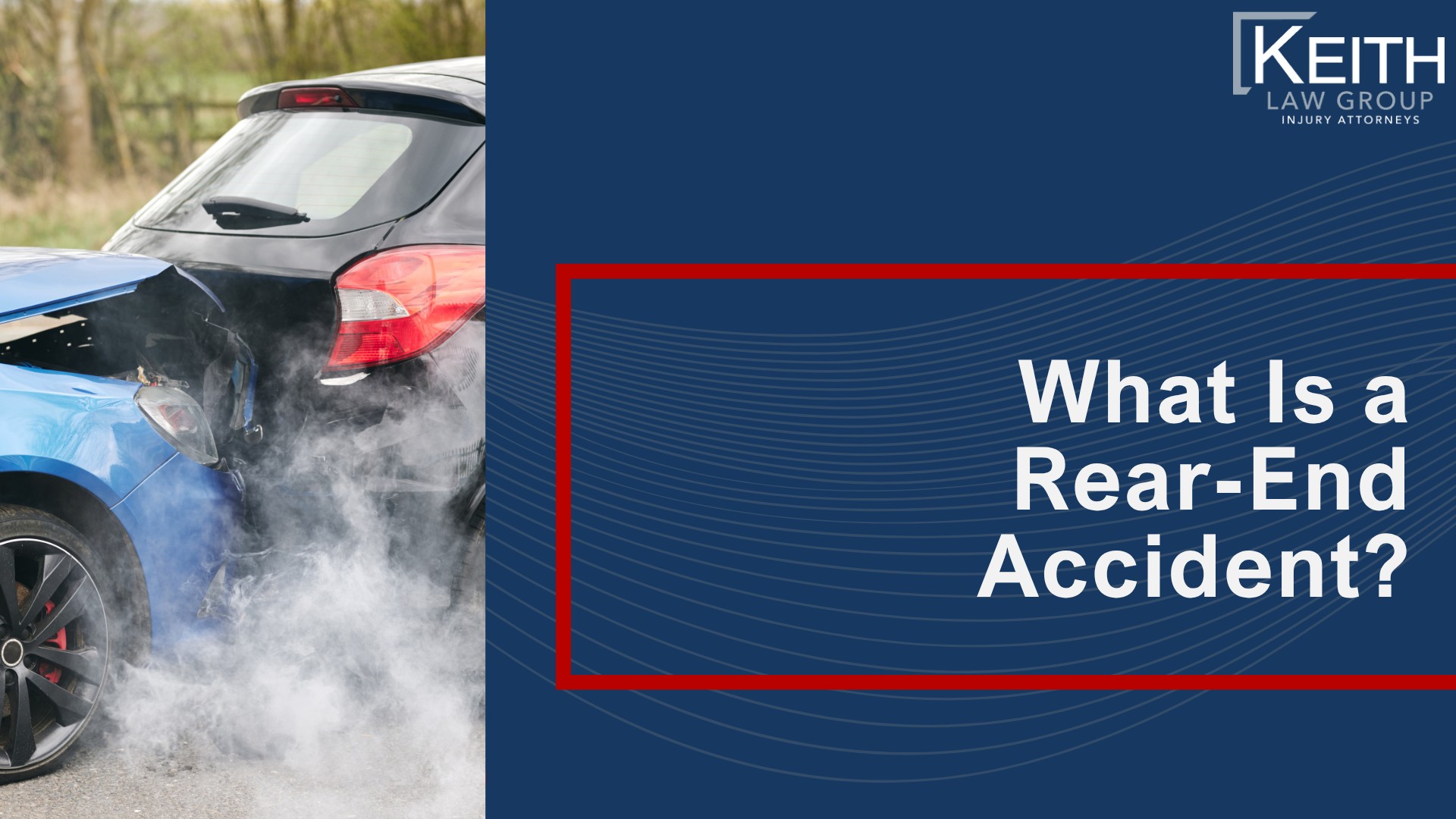
A rear-end accident occurs when one vehicle strikes the back of another vehicle traveling in the same direction.

These crashes range from low-speed impacts in parking lots or at traffic lights to high-speed collisions on Arkansas highways and interstates.

Rear-end collisions account for approximately 29% of all motor vehicle crashes nationwide, making them one of the most common types of traffic accidents.

Many occur in stop-and-go traffic, at intersections, during sudden slowdowns, or when a driver is distracted and fails to react to changing traffic conditions.

Although some rear-end crashes cause only minor property damage, others result in serious injuries that require extensive medical treatment.

The force of the impact can throw occupants forward and backward within the vehicle, causing injuries to the neck, spine, head, shoulders, and other parts of the body.

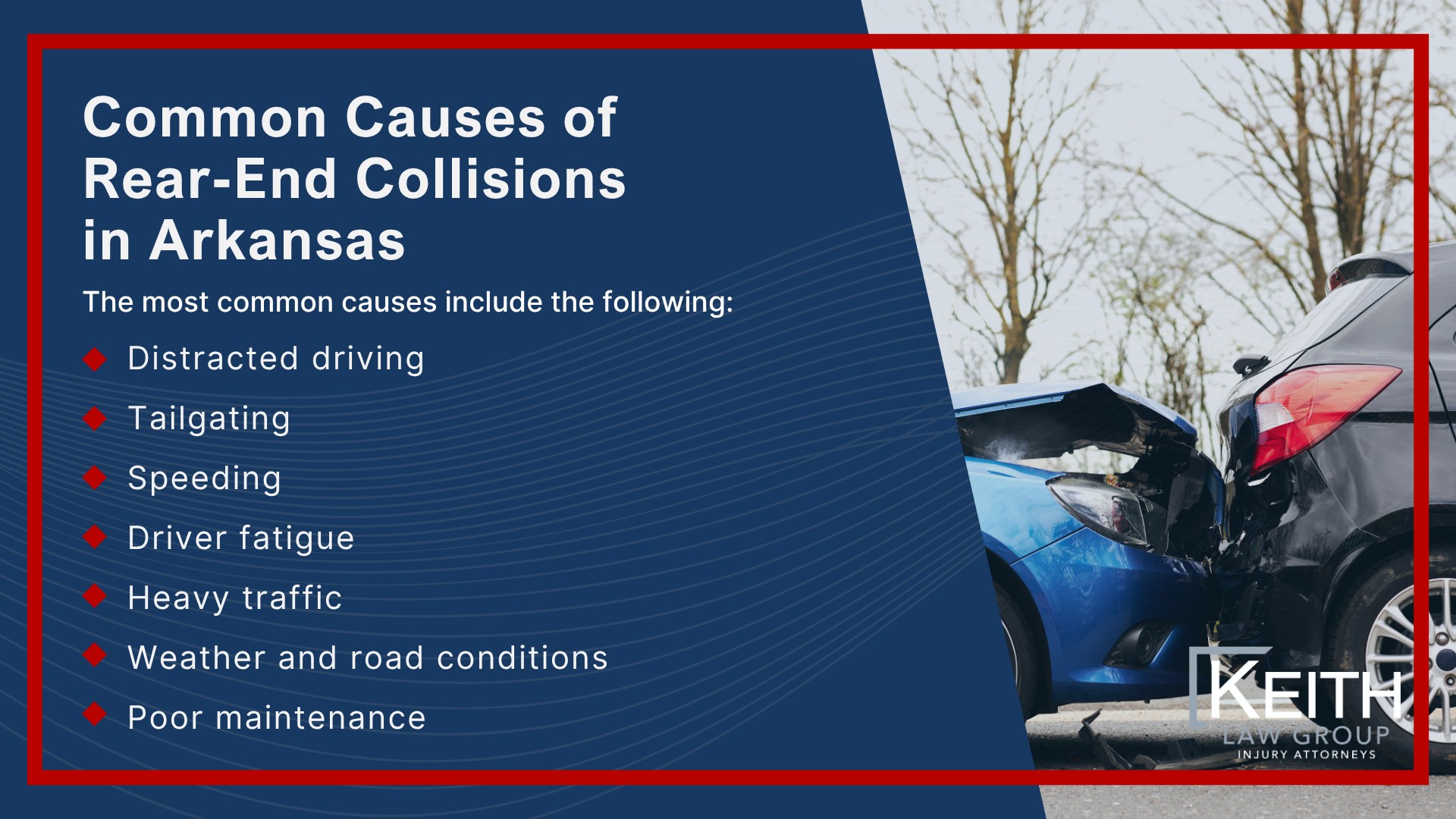
Common Causes of Rear-End Collisions in Arkansas

Most of these crashes happen because of driver error.

The primary cause of rear-end accidents is driver negligence.

Nearly every cause maps to a failure of attention, speed, or following distance.

The most common causes include the following:

  • Distracted driving: A driver on the phone loses the seconds needed to stop. Distracted driving reduces a driver’s reaction window.
  • Tailgating: Following too closely leaves no room to brake. The trailing driver who cannot stop carries the fault.
  • Speeding: A driver above the posted speed limits needs more distance than is left.
  • Driver fatigue: A drowsy driver reacts late or not at all.
  • Heavy traffic: Stop-and-go conditions invite these crashes. Heavy traffic increases the likelihood of rear-end accidents.
  • Weather and road conditions: Rain and reduced traction lengthen stopping distance, and a driver has to slow to match the road.
  • Poor maintenance: Worn brakes and uneven tire wear can leave a driver unable to stop. Poor vehicle maintenance can lead to brake failure in rear-end crashes.

Rear-end accidents often occur due to distracted driving. A driver who looks away from stopped cars has failed the duty Arkansas places on every motorist.

Determining Liability in a Rear-End Accident in Arkansas

Liability in an Arkansas rear-end accident depends on more than the position of the vehicles after impact.

The driver in the rear is often the primary focus because Arkansas law requires every motorist to leave enough distance to stop safely.

That does not mean fault is automatic.

The claim still turns on the evidence showing how fast each driver was traveling, whether traffic changed suddenly, whether the lead vehicle gave proper warning, and whether either driver violated a traffic safety rule.

If both drivers share responsibility, Arkansas comparative fault law determines how much compensation the injured person can recover.

Following-Distance Rules Under Arkansas Law

Arkansas law requires drivers to follow at a distance that is reasonable and prudent under the circumstances.

Arkansas Code 27-51-305 makes following too closely a traffic violation when the distance between vehicles is unsafe for the speed, traffic, and road conditions.

In a rear-end collision, that rule often becomes central because the trailing driver must be able to react to slowing or stopped traffic ahead.

Large trucks face an additional rule outside towns, where one truck generally may not follow another truck within 200 feet.

When a driver tailgates, speeds, or fails to adjust for traffic and weather, that conduct can support a finding that the driver breached the duty to operate the vehicle safely.

Following Driver Fault in a Rear-End Collision

The following driver is found liable in many rear-end crashes because that driver usually had the duty and opportunity to stop before impact.

Arkansas does not, however, automatically assign legal fault to the rear driver in every case.

A following-too-closely violation may serve as evidence of negligence, but the insurer, judge, or jury still evaluates the conduct of both drivers before assigning fault.

Evidence such as vehicle damage, brake-light function, skid marks, dashcam footage, witness statements, and event-data recorder information can confirm whether the rear driver was distracted, speeding, tailgating, or braking too late.

Insurance companies may initially treat the rear driver as responsible, but a strong claim still needs evidence that proves why the collision happened.

Lead Driver Fault in a Rear-End Collision

A lead driver may share fault when their own conduct creates an unreasonable danger for the driver behind.

Sudden stops without a valid reason, brake checking, unsafe lane changes, reversing, or driving with nonfunctioning brake lights can all affect how liability is assigned.

Arkansas courts evaluate these crashes based on the facts rather than assuming the driver in front is always free from blame.

A rear driver may still be responsible if they were following too closely or not paying attention, but the lead driver’s actions can reduce or shift liability when those actions contributed to the crash.

That fact-specific analysis is why physical evidence, witness statements, and vehicle data matter in disputed rear-end claims.

Arkansas Modified Comparative Fault Rule

Arkansas uses a modified comparative fault rule under Arkansas Code 16-64-122.

Each driver may be assigned a percentage of responsibility, and the injured person’s compensation is reduced by their share of fault.

For example, a driver who is 25 percent at fault for a $100,000 claim may recover $75,000, while a driver who is 49 percent at fault may recover $51,000.

If the injured driver is 50 percent or more at fault, Arkansas law bars recovery entirely.

Because every percentage point affects the value of the claim, insurance companies often look for facts that allow them to place part of the blame on the injured driver.

A rear-end accident claim should be built with evidence that addresses fault directly before the insurer’s version of the crash controls the negotiation.
Parties Who May Be Held Liable for a Rear-End Accident

The driver who caused the collision is often the primary defendant in a rear-end accident claim, but liability is not always limited to a single person or company.

Depending on how the crash occurred, multiple parties may have contributed to the accident and may share responsibility for the resulting injuries and damages.

Identifying every potentially liable party is important because it can affect the insurance coverage available to compensate the injured person.

Parties that may be held liable in an Arkansas rear-end accident include:

  • At-fault driver: The driver who was distracted, tailgating, speeding, impaired, fatigued, or otherwise failed to stop in time.
  • Employer or motor carrier: If the driver was performing job duties at the time of the crash, an employer may be responsible for the employee’s negligence under Arkansas law.
  • Commercial trucking company: A trucking company may face liability for negligent hiring, training, supervision, maintenance, or other conduct separate from the driver’s actions.
  • Vehicle manufacturer: A defective brake system, tire failure, steering defect, or other product defect may support a separate product liability claim.
  • Repair or maintenance company: A repair shop may share responsibility if negligent maintenance or improper repairs contributed to the collision.
  • Government entity: Dangerous road conditions, malfunctioning traffic signals, poor roadway design, or inadequate maintenance may create potential claims against a public agency, subject to applicable notice requirements and legal limitations.
  • Vehicle owner: An owner who knowingly entrusts a vehicle to an inexperienced, reckless, impaired, or otherwise unsafe driver may share liability under a negligent entrustment theory.

Determining liability often requires a detailed investigation of the crash, the vehicles involved, the parties responsible for maintaining them, and the circumstances leading up to the collision.

Liability in Common Rear-End Scenarios

Although many rear-end collisions involve similar circumstances, liability ultimately depends on the specific facts of the crash.

Physical evidence, vehicle damage, witness statements, electronic data, and traffic conditions often reveal which driver acted unreasonably and whether more than one party contributed to the collision.

Some of the most common rear-end accident scenarios seen in Arkansas include:

  • Tailgating driver: Drivers who follow too closely often do not have enough time or distance to react when traffic slows or stops. In these cases, the trailing driver is frequently found responsible for the collision.
  • Distracted driver: A driver looking at a phone, navigation system, or another distraction may fail to notice stopped traffic ahead. Phone records, dashcam footage, and witness testimony can help establish what happened before impact.
  • Sudden stop or brake check: A lead driver who stops unexpectedly without a legitimate reason may share fault for the crash. Determining liability often requires examining traffic conditions, vehicle data, and the actions of both drivers.
  • Malfunctioning brake lights: Drivers rely on brake lights to recognize when traffic ahead is slowing. A vehicle with inoperable brake lights may reduce the warning available to following drivers and affect how fault is assigned.
  • Commercial truck collisions: Large trucks require substantially more distance to stop than passenger vehicles. When a commercial truck causes a rear-end collision, the driver, trucking company, maintenance provider, or other parties may share responsibility.
  • Chain-reaction crashes: Multi-vehicle rear-end collisions can create complex liability disputes involving several drivers. Investigators often examine the sequence of impacts to determine which driver or drivers caused the chain reaction.

The circumstances of a rear-end accident can significantly affect how liability is evaluated, which is why a thorough investigation is often necessary before fault can be assigned accurately.

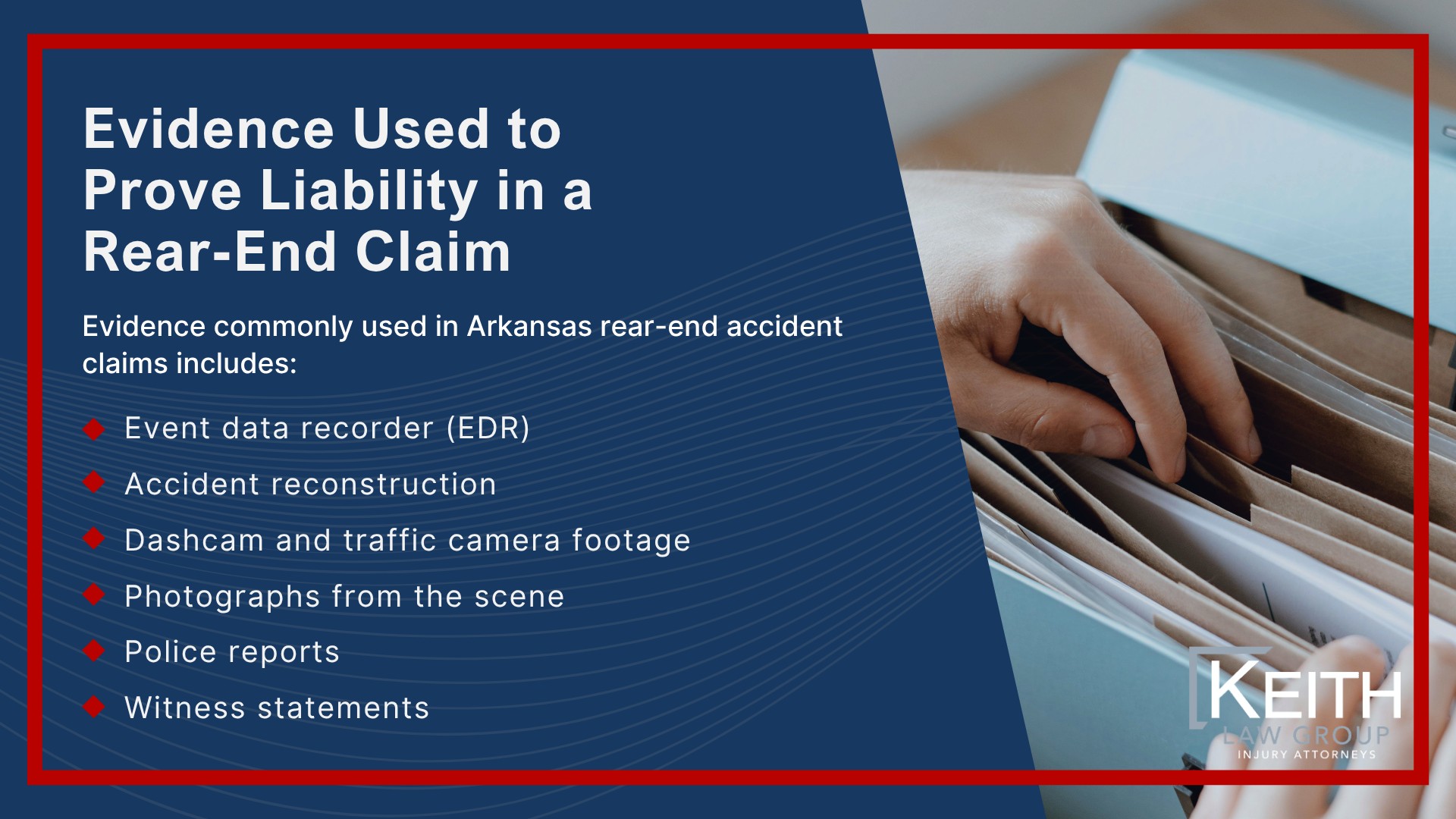
Evidence Used to Prove Liability in a Rear-End Claim

Liability in a rear-end accident is often determined by the quality of the available evidence.

While some collisions involve little disagreement about what happened, others quickly become disputes over following distance, speed, braking, driver attention, road conditions, or the actions of the lead vehicle.

Objective evidence is often the most effective way to establish fault and challenge attempts by an insurance company to shift blame onto the injured driver.

Evidence commonly used in Arkansas rear-end accident claims includes:

  • Event data recorder (EDR): Often referred to as a vehicle’s “black box,” the event data recorder may capture speed, braking activity, throttle position, and other information from the seconds leading up to the collision.
  • Brake-light inspections: Examining the lead vehicle’s brake lights can help determine whether the following driver received adequate warning that traffic was slowing or stopping.
  • Accident reconstruction: Reconstruction experts analyze vehicle damage, skid marks, road conditions, and other physical evidence to evaluate how the collision occurred.
  • Dashcam and traffic camera footage: Video evidence can provide a direct record of vehicle movements, traffic conditions, and driver actions immediately before impact.
  • Photographs from the scene: Images of vehicle positions, damage patterns, roadway conditions, debris fields, and skid marks often preserve important details that disappear once the vehicles are moved.
  • Police reports: Although a police report does not determine fault, it frequently contains diagrams, witness information, observations from the investigating officer, and citations issued after the crash.
  • Witness statements: Independent witnesses can provide valuable testimony regarding vehicle speed, following distance, traffic conditions, and the sequence of events leading to the collision.

The physical damage to the vehicles can also reveal important information about the force and angle of impact.

In some cases, investigators use crush damage, impact points, and other vehicle data to better understand how the crash occurred and whether either driver’s account is consistent with the available evidence.

Because electronic data, surveillance footage, and other forms of evidence may be lost or overwritten over time, preserving this information as early as possible can be critical to a successful claim.

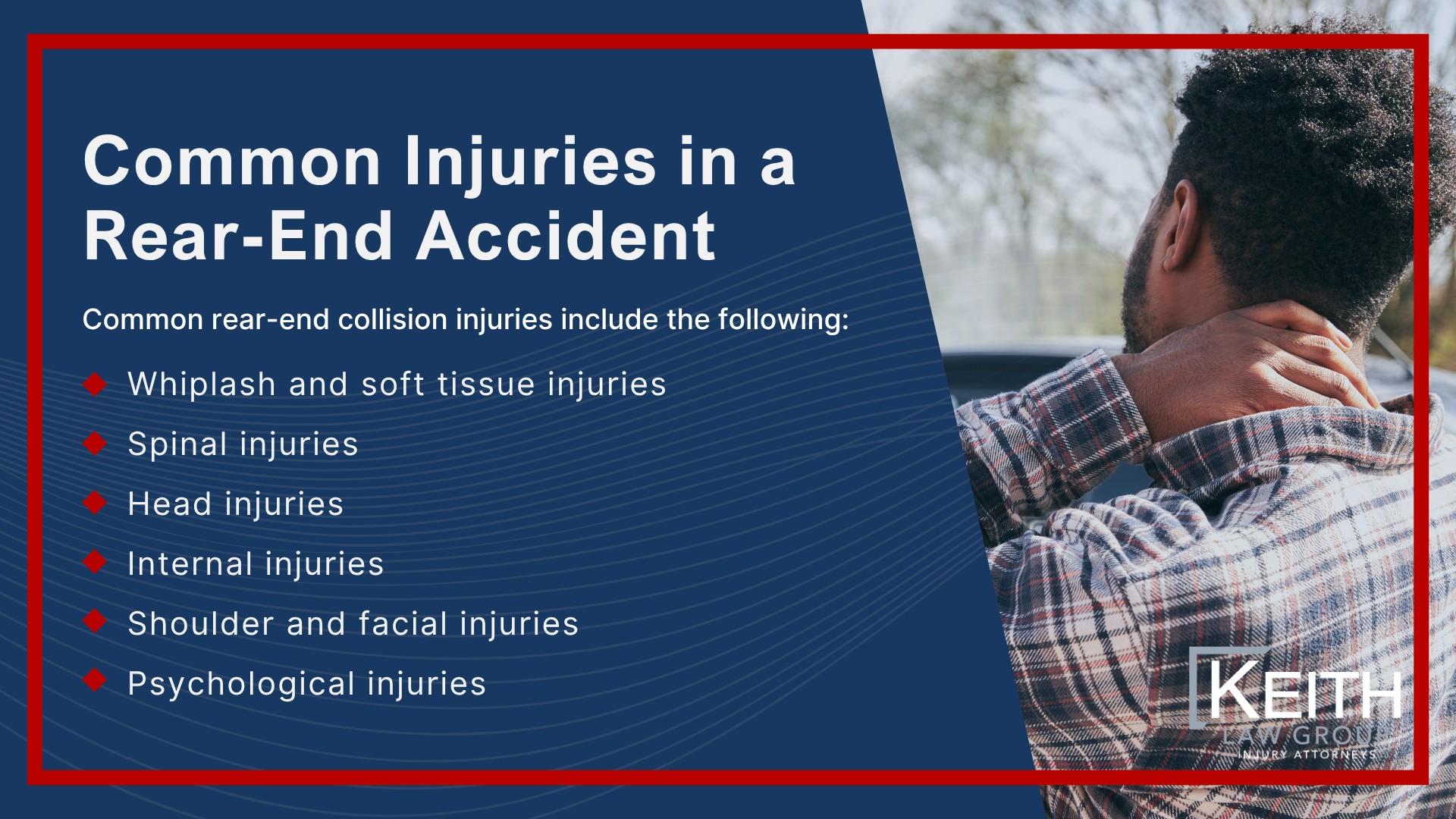
Common Injuries in a Rear-End Accident

A rear-end impact throws the body forward and back.

The motion forces the neck past the spine’s natural curve and injures the neck, spine, and head even at low speed.

Most people involved in one of these wrecks come away with an injury of some kind. Soft tissue injuries are the most common, and many drivers suffer whiplash before they feel any pain.

Rear-end accident injuries run from minor strains to permanent harm. Severe injuries can need surgery, and a high-speed hit can leave catastrophic injuries that change a life.

Many of those injuries do not appear at the scene. Adrenaline can mask pain for hours, so the absence of pain at the scene means little.

Common rear-end collision injuries include the following:

  • Whiplash and soft tissue injuries: Whiplash is a common injury in rear-end collisions, and the soft tissue damage behind it can keep the neck pain going for months. Injuries like whiplash may take hours or days to show symptoms after a crash, and up to 40% of whiplash victims may never fully recover.
  • Spinal injuries: A hard impact can cause spinal injuries that run from a herniated disc to spinal cord injuries. Spinal cord injuries can mean chronic pain or partial or complete paralysis.
  • Head injuries: Traumatic brain injuries can occur from rear-end collisions when the head strikes a window or headrest. Traumatic brain injuries need prompt evaluation, and a severe head injury can support a separate traumatic brain injury claim.
  • Internal injuries: The chest and head can strike the steering wheel, and the belt or steering wheel can bruise organs or cause internal bleeding not visible at first.
  • Shoulder and facial injuries: The belt and airbag protect the body, yet can leave shoulder injuries and facial cuts.
  • Psychological injuries: Anxiety, chronic pain, and post traumatic stress disorder follow many serious wrecks.

A prompt medical exam protects your health and your claim. The physical injuries from a rear end wreck often pair with anxiety and other strain, and a documented injury connected to the date of the crash is hard for an insurer to dispute later.

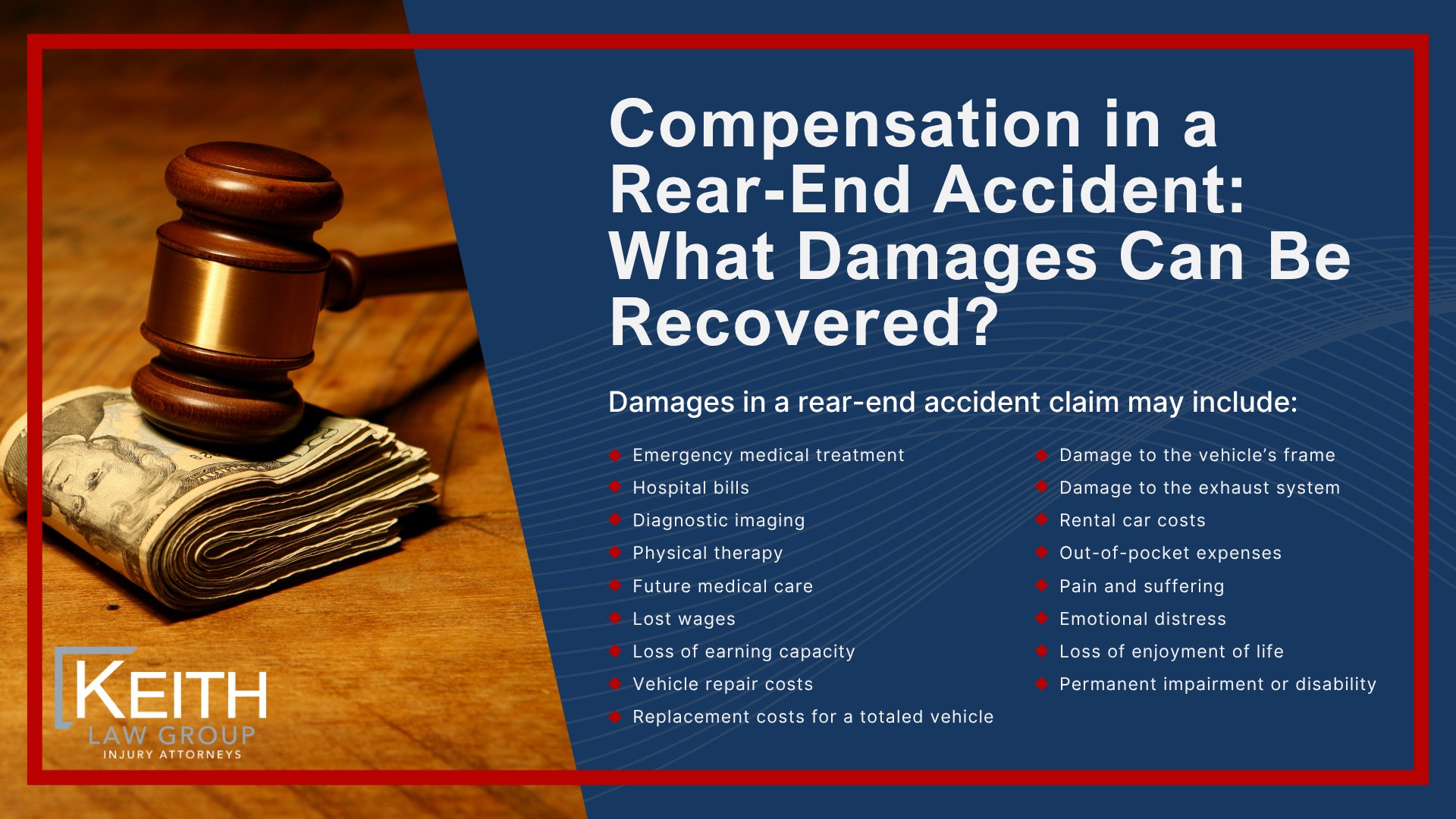
Compensation in a Rear-End Accident: What Damages Can Be Recovered?

Compensation in a rear-end accident claim depends on the injuries, vehicle damage, lost income, treatment needs, and fault assigned under Arkansas law.

A serious rear-end impact can damage a vehicle’s frame, exhaust system, sensors, and other components tied to the vehicle’s safety, often leading to costly repairs beyond visible bumper damage.

Injured drivers may also recover medical expenses, lost wages, and future losses when the crash affects their health or ability to work.

Arkansas law may also allow injured drivers to recover non economic damages for pain, emotional distress, physical limitations, and the loss of normal daily activities.

The value of a claim depends on the evidence supporting each category of loss and the percentage of fault assigned to each driver.

Damages in a rear-end accident claim may include:

  • Emergency medical treatment
  • Hospital bills
  • Diagnostic imaging
  • Physical therapy
  • Future medical care
  • Lost wages
  • Loss of earning capacity
  • Vehicle repair costs
  • Replacement costs for a totaled vehicle
  • Damage to the vehicle’s frame
  • Damage to the exhaust system
  • Rental car costs
  • Out-of-pocket expenses
  • Pain and suffering
  • Emotional distress
  • Loss of enjoyment of life
  • Permanent impairment or disability

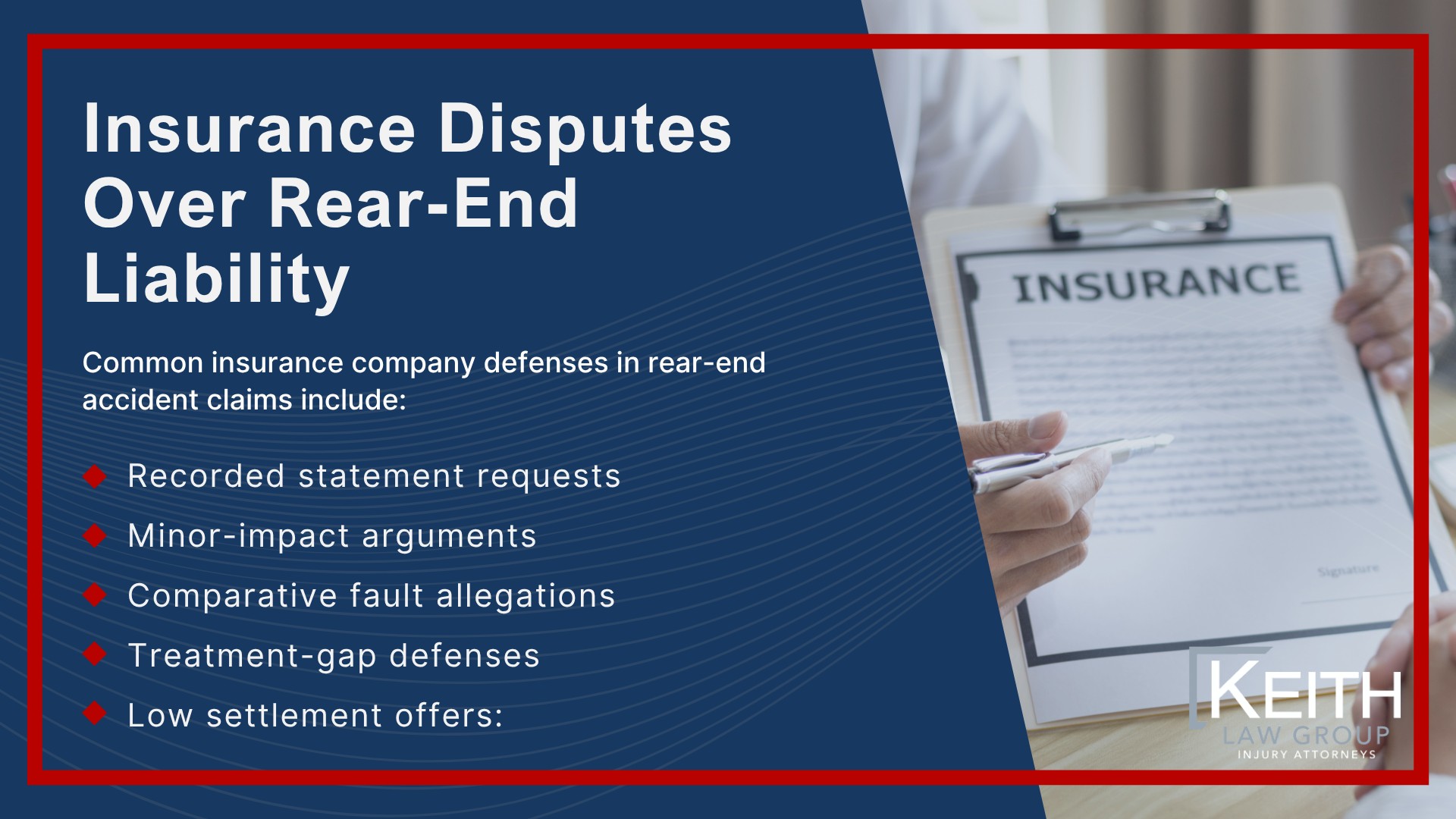
Insurance Disputes Over Rear-End Liability

Insurance companies often begin investigating a rear-end accident within days of the crash.

Even when liability appears straightforward, adjusters may examine the evidence closely for opportunities to reduce the value of the claim or assign a percentage of fault to the injured driver.

Arkansas is not a no fault insurance state, which means the at-fault driver’s insurer is generally responsible for paying covered damages resulting from the collision.

Although Arkansas does not require drivers to carry personal injury protection coverage, some motorists have personal injury protection or uninsured/underinsured motorist coverage available through their own insurance company depending on the circumstances of the crash.

Common insurance company defenses in rear-end accident claims include:

  • Recorded statement requests: Adjusters often seek recorded statements early in the process and may later use comments about speed, braking, or traffic conditions to challenge the claim.
  • Minor-impact arguments: The insurer argues that limited vehicle damage means the injuries could not be serious.
  • Comparative fault allegations: The carrier attempts to assign a percentage of blame to the injured driver to reduce the amount it must pay.
  • Treatment-gap defenses: Delays in seeking medical care may be used to argue that the injuries were unrelated to the crash or less severe than claimed.
  • Low settlement offers: Initial offers may undervalue the claim before the full extent of the injuries, treatment, and losses is known.

Medical records, vehicle damage evidence, witness statements, crash data, and other documentation often play a critical role in responding to these defenses.

The value of a rear-end accident claim ultimately depends on the severity of the injuries, the available insurance coverage, the evidence supporting liability, and the percentage of fault assigned to each party.

Steps to Take After a Rear-End Crash in Arkansas

What you do in the first hour shapes the medical record and the claim.

When a rear end collision occurs, safety and proof come first.

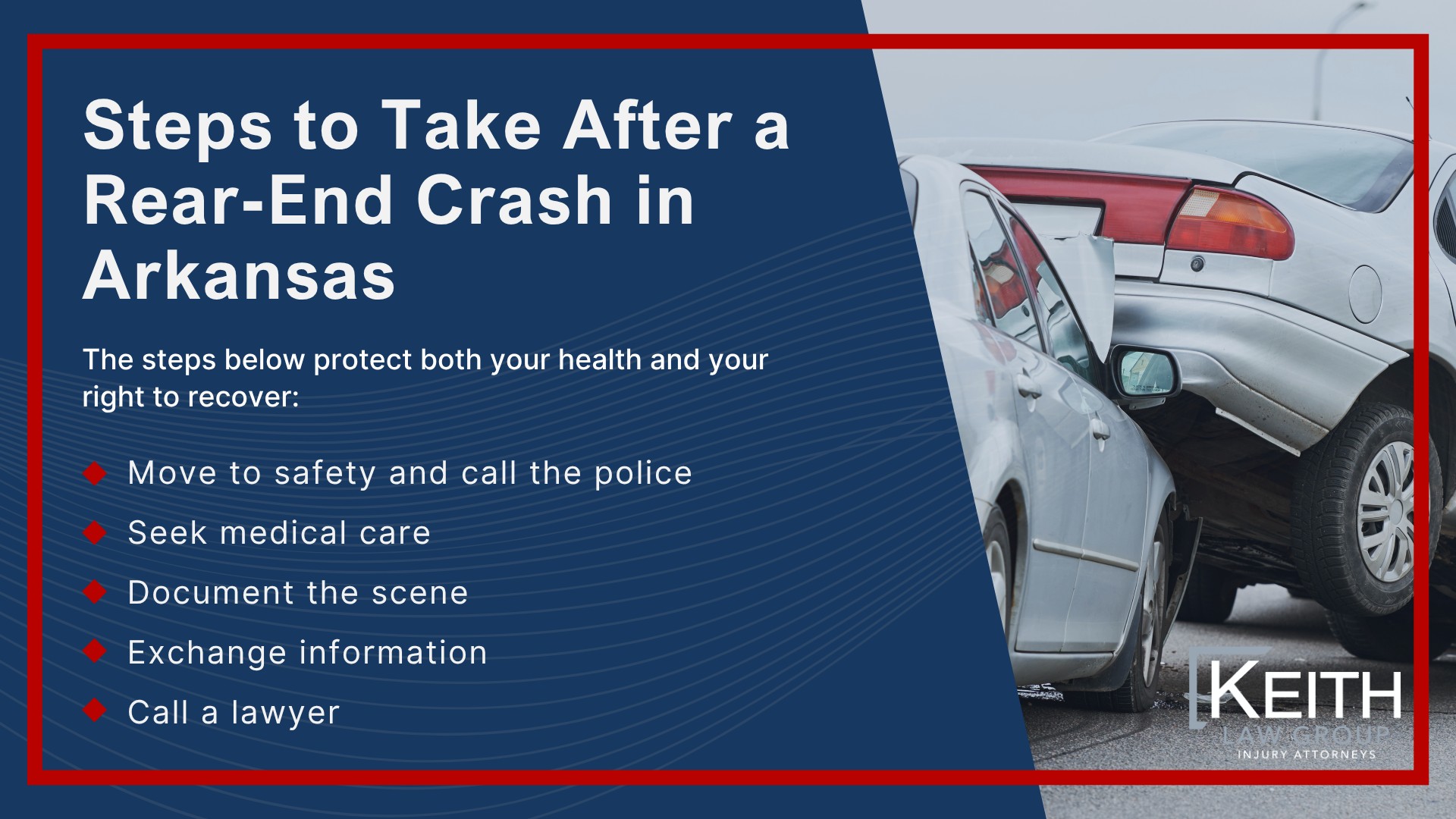
The steps below protect both your health and your right to recover:

  • Move to safety and call the police: Many rear end accidents happen in live traffic, so get clear of the lane and report the crash.
  • Seek medical care: Seek medical attention promptly, since a driver who suffered injuries may not feel them until the next day, and a gap in medical attention gives the insurer an opening.
  • Document the scene: Photograph the vehicles, the damage, and the road, and gather the names of any witnesses.
  • Exchange information: Trade insurance and contact details with the other driver in the rear end car accident.
  • Call a lawyer: A personal injury lawyer can preserve the evidence before it disappears.

A rear end collision claim is stronger when these steps are taken early. The record built in the first days is the record an insurer finds hardest to dispute.

Statute of Limitations for Rear-End Claims in Arkansas

An injured driver has 3 years from the crash to file a personal injury lawsuit under the Arkansas statute of limitations for car accident claims. The same window applies to property damage.

A delayed-onset spine or head injury does not reset the clock. A fatal crash carries its own 3-year deadline from the date of death.

A crash involving a public vehicle runs on a shorter notice deadline that can expire within months.

Arkansas also requires a written SR-1 report within 30 days of any crash causing injury or property damage above 1,000 dollars.

Missing the deadline ends the right to recover.

The strength of the evidence does not matter once the clock runs out.

Speak With an Arkansas Rear-End Accident Lawyer at Keith Law Group

Rear-end accident claims often involve more than determining which vehicle struck the other.

Questions about following distance, distracted driving, comparative fault, vehicle damage, medical treatment, and insurance coverage can all affect the outcome of a case.

Insurance companies frequently investigate these crashes immediately and may attempt to reduce their exposure by disputing liability, minimizing injuries, or assigning fault to the injured driver.

Building a strong claim requires evidence that clearly shows how the collision occurred and how the injuries have affected the victim’s life.

Keith Law Group represents Arkansas drivers and passengers injured in rear-end collisions.

Our firm investigates the crash, preserves important evidence, works with experts when necessary, and pursues compensation for medical expenses, lost income, pain and suffering, property damage, and other losses allowed under Arkansas law.

Whether the crash involved a distracted driver, a commercial vehicle, a chain-reaction collision, or disputed fault, Keith Law Group can evaluate the facts and explain the legal options available.

If you or a loved one suffered serious injuries in a rear-end accident in Arkansas, you may be eligible to file a claim and seek compensation.

Reach out to an experienced Arkansas car accident attorney at Keith Law Group today for a free, no-obligation consultation.

Call (479) 326-7734 or use the chat feature on this page for a free case review and an instant case evaluation.

Frequently Asked Questions

Published by:
Share

This article has been written and reviewed for legal accuracy and clarity by the team of writers and attorneys at Keith Law Group and is as accurate as possible. This content should not be taken as legal advice from an attorney. If you would like to learn more about our owner and experienced injury lawyer, Sean T. Keith, you can do so here.

Keith Law Group does everything possible to make sure the information in this article is up to date and accurate. If you need specific legal advice about your case, contact us. This article should not be taken as advice from an attorney.

Other Car Accident Lawsuit Resources
All
FAQs
Injuries & Conditions
Legal Help
Other Resources
Settlements & Compensation
You can learn more about other Car Accident Lawsuit resources below:
15 Common Car Accident Causes in Arkansas & Prevention Tips
Arkansas Auto Accidents: How to File a Car Insurance Claim
Arkansas Car Accident Compensation Types & Laws to Know
Arkansas Car Accident Injury Claim Process
Arkansas Car Accident Lawsuit Guide: Tips for Success
Arkansas DUI Accident Lawsuits: Laws, Damages, & Safety Tips
Arkansas Hit and Run Accident Guide: Laws & Tips to Know
Average Arkansas Car Accident Settlements & Tips to Maximize Yours
Car Accident Damages in Arkansas: Potential Compensation
Car Accident Reporting in Arkansas
Car Accident Statute of Limitations Arkansas
Common Types of Accidents in Arkansas
Finding the Best Car Accident Attorney in Arkansas for Your Case
Hit and Run Car Accident Lawsuits in Arkansas
How Is Fault Determined in Arkansas Auto Wrecks?
How Much Can Someone Sue for a Car Accident in Arkansas
How Much Does a Car Accident Lawyer Cost to Hire in Arkansas?
How to File a Police Report After a Car Accident in Arkansas
How to File an Auto Accident Lawsuit in Arkansas
How to Get a Police Report After a Car Accident in Arkansas
Liability in Multi-Vehicle Accidents in Arkansas
Should I Get a Lawyer for a Car Accident?
Sideswipe Accident Liability in Arkansas
Statute of Limitations: Car Accident Claims in Arkansas
Steps to Take After a Car Accident in Arkansas
T-Bone Accident Liability in Arkansas
T-Bone Car Accident Lawsuits in Arkansas: Things to Know
Types of Evidence in Arkansas Car Accident Cases
Understanding Car Accident Insurance Claims in Arkansas
Understanding the Arkansas Car Accident Settlement Process
Who Pays for My Medical Bills After a Car Accident in Arkansas

Other Car Accident Lawsuit Resources

All
FAQs
Legal Help
Other Resources
Settlements & Compensation