175 Reviews
5.0
★★★★★

Arkansas Car Accident Injury Claim Process

Filing a Car Accident Injury Claim in Arkansas

According to the Arkansas Department of Public Safety, hundreds of people are injured and even killed on state roads every year due to motor vehicle accidents.

In 2023, Arkansas recorded 590 traffic fatalities.

The year before, that number was 643.

For personal injury victims across Arkansas, the period after a crash brings medical treatment, missed work, and an insurance claim process that most people have never dealt with before.

Getting that process right from the start is what determines how much of those losses can be recovered.

What many claimants do not realize is that the insurance adjuster reviewing their claim works for the insurer, not for them.

Their job is to assess the claim in a way that limits what the insurer pays, and without legal help, most claimants do not recognize what is happening until the damage is already done.

This page walks through the Arkansas car accident injury claim process step by step, explaining what each stage requires and where legal representation changes what a claimant can recover.

Arkansas Car Accident Injury Claim Process

At Keith Law Group, our legal team works to represent clients by reviewing the car accident injury claim, confirming that the submitted information is accurate, addressing insurer challenges, and handling negotiations as part of their legal services when fault, injuries, or compensation are disputed.

As a personal injury law firm serving clients across Little Rock, Northwest Arkansas, Fort Smith, and Pulaski County, Keith Law Group provides one on one attention to every car accident injury claim from start to finish.

Parties Who Can File a Car Accident Injury Claim in Arkansas

In Arkansas, the right to file a car accident injury claim depends on who sustained harm in the collision and whether that harm is legally connected to the crash.

An injured driver, passenger, or other affected individual may bring a claim when the injuries arise from someone else’s negligence, provided the claim can be tied to the accident and resulting damages.

When the injured person cannot act independently, such as in the case of a minor or an incapacitated adult, a parent, guardian, or appointed representative may file and manage the claim on their behalf.

This allows the claim to proceed as a recognized legal matter while protecting the interests of the injured party.

In fatal crashes, Arkansas law allows a wrongful death claim to be filed by the personal representative of the deceased person’s estate.

This individual is appointed by a probate court to act on behalf of the estate.

If no personal representative has been appointed, the claim may be brought by the deceased person’s legally recognized family members, such as a spouse, children, or parents, as defined under Arkansas law.

These claims may involve additional legal issues, particularly where multiple family members are involved or where the right to file is disputed.

In such situations, an Arkansas personal injury lawyer or experienced personal injury lawyer may review who has standing to proceed as part of handling the wrongful death claims.

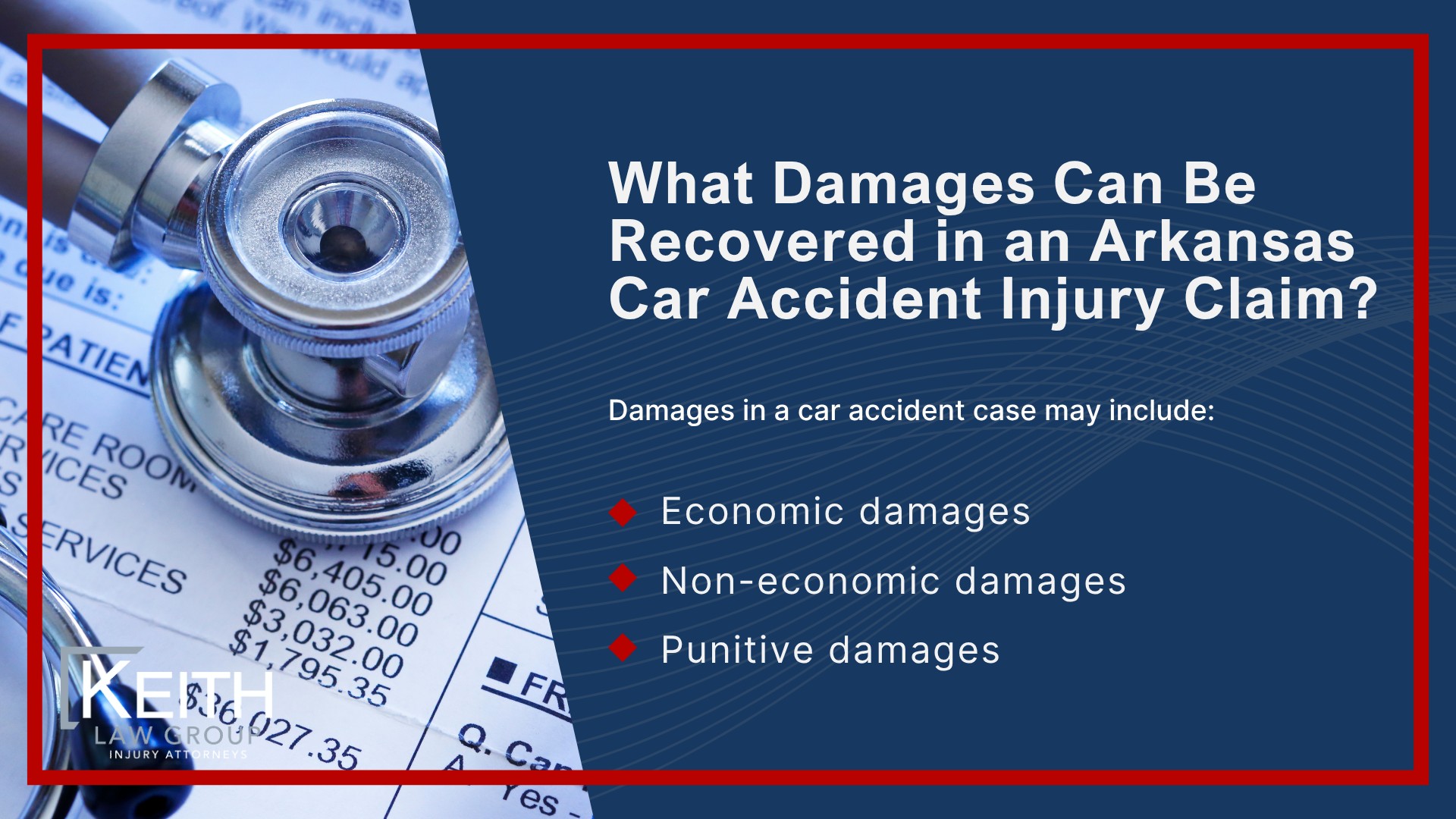
What Damages Can Be Recovered in an Arkansas Car Accident Injury Claim?

Damages in an Arkansas car accident injury claim are divided into economic, non-economic, and, in limited cases, punitive damages.

What can be recovered depends on the injuries and the records that support the claim.

Damages in a car accident case may include:

  • Economic damages: These are financial losses that can be shown through bills and records. Compensation for medical expenses can include ambulance rides, surgeries, hospital stays, rehabilitation expenses, and medication costs, which can total tens of thousands of dollars, and may also include lost wages, property damage, and other expenses tied to the accident. If treatment continues or the injury does not resolve, these damages may also include future care and loss of income.
  • Non-economic damages: Non-economic damages for pain and suffering often reflect the severity of injuries and their implications on the victim’s quality of life. This may include pain, ongoing symptoms, and changes in how the person functions after the accident. Where the injury does not resolve, recovery may also include reduced ability to work over time because if injuries from a car accident are permanent, the negligent driver may be responsible for future earnings lost due to the inability to work.
  • Punitive damages: These apply in limited cases based on the conduct of the driver. Punitive damages may be awarded in cases of egregious negligence to punish the defendant and deter similar behavior in the future, but they are not available in every claim.

During your initial consultation, it is advisable to interview your potential lawyer to ensure you feel comfortable working with them.

What a Car Accident Injury Claim Involves in Arkansas

A car accident injury claim in Arkansas involves preparing and submitting a claim that allows an insurer to evaluate liability, injuries, and coverage based on the facts of the crash.

The claim must include the accident report details, the identity of the drivers involved, and the insurance company’s policy under which the claim is made.

The insurer reviews fault, injuries, and coverage based on the claim file.

These elements are examined together during claim handling rather than separately.

For many personal injury victims, the claim file becomes the basis on which insurance companies determine fault and assess whether compensation can be pursued through the personal injury claims process.

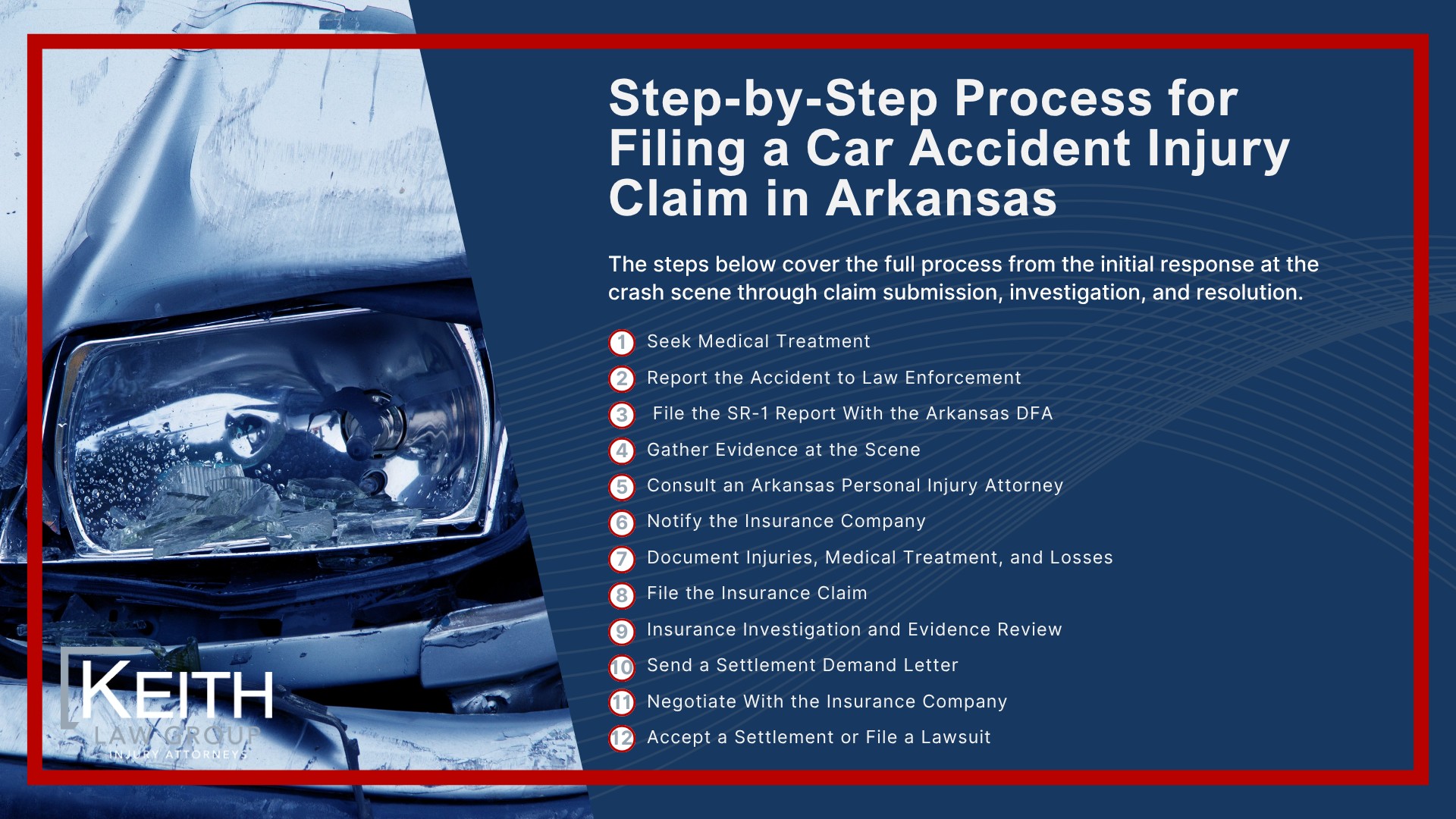
Step-by-Step Process for Filing a Car Accident Injury Claim in Arkansas

A car accident injury claim in Arkansas is filed against the at-fault driver under the state’s fault-based insurance system, which means the claim process is built around establishing the other driver’s negligence, documenting the resulting injuries, and presenting losses to the insurer in a form that supports full recovery.

Under Arkansas insurance regulations, a carrier must acknowledge a filed claim within 15 business days and complete its investigation within 45 calendar days.

How the claim is documented and submitted at each stage directly affects how the insurer evaluates fault, values the injuries, and responds to the demand.

The steps below cover the full process from the initial response at the crash scene through claim submission, investigation, and resolution.

Step 1 — Seek Medical Treatment

Immediately seek medical attention after a car accident to treat injuries and create a formal record. Common injuries from car accidents include broken bones, soft tissue injuries, and traumatic brain injuries, some of which may not produce immediate symptoms.

Medical records created close to the time of the crash establish that the injuries were reported and treated as part of the same incident.

Where there is a delay, insurance companies may rely on that gap to question whether the condition is related to the accident.

Symptoms that develop gradually, including chronic pain from soft tissue injuries, are among the most frequently disputed in claims.

As treatment continues, the records from each visit form the medical history relied on in the claim, including the medical bills submitted for reimbursement.

Step 2 — Report the Accident to Law Enforcement

After an accident, the steps you take immediately can significantly impact your ability to file a claim, including calling 911 and obtaining a police report.

Calling 911 immediately after a car accident ensures that police and emergency medical personnel arrive at the scene, which is crucial for serious injuries.

Once officers arrive at the accident scene, they document statements from the drivers and witnesses, the position of the vehicles, road conditions, and any citations issued.

Obtaining a police report after an accident is invaluable for determining liability, as it provides an official account of the incident.

These recorded details are later used during claim review to assess how the collision occurred and to determine fault based on the observations made at the scene.

Step 3 — File the SR-1 Report With the Arkansas DFA

Arkansas requires drivers to file an SR-1 report with the Department of Finance and Administration when a crash results in injury, death, or property damage exceeding $1,000.

The SR-1 is separate from the police report and must be filed within 30 days of the accident.

It identifies the drivers, vehicles, and responsible parties involved and confirms that insurance coverage was in place at the time of the crash.

Proof of insurance must also be provided to the Office of Driver Services within 90 days.

Failure to complete this filing when required can affect the driver’s license status and leave the car accident injury claim incomplete from a reporting standpoint.

Step 4 — Gather Evidence at the Scene

Gather witness information including names, contact info, and insurance details of all involved parties.

Evidence like photos, police reports, and witness statements are crucial for a strong claim.

Photographs should capture vehicle positions, points of impact, traffic signals, and physical details such as skid marks, debris, and lane markings.

Taking photos of the accident scene, including vehicle damage and any relevant road conditions, can provide valuable evidence for your case.

Each type of evidence is reviewed differently during claim handling.

Photographs document the physical layout of the crash, while witness statements provide independent accounts of how the collision occurred.

Further, collecting contact information from witnesses at the scene can help establish fault and support your claim later on.

These materials are evaluated together by the insurer to reconstruct the sequence of events and determine fault based on the available evidence.

Step 5 — Consult an Arkansas Personal Injury Attorney

Consulting with a personal injury attorney as soon as possible after an accident is vital to ensure your rights are protected and evidence is preserved, particularly in cases involving car wrecks caused by others negligence.

When choosing a personal injury lawyer, consider their history with past cases, trial experience, and win record. This helps determine whether the attorney has handled similar claims and can provide the level of legal representation expected from experienced legal professionals.

In practice, the way a claim is handled can directly affect how it is valued and resolved, particularly where fault, medical treatment, or losses are disputed.

Consulting an experienced personal injury attorney as soon as possible is vital to preserve your rights and ensure just compensation remains available, as early involvement allows the attorney to manage communication with insurers and address issues before the claim moves further, including steps needed to pursue compensation and seek maximum compensation where supported by the record.

Step 6 — Notify the Insurance Company

Report the injury to the appropriate responsible parties immediately after the accident.

Most policies require prompt notice as a condition of coverage, and delays give insurers grounds to challenge the claim before it moves forward.

Notify your insurance company within 24 to 48 hours after the accident.

The initial report should cover the basic facts: date, location, and parties involved, without providing a recorded statement or accepting fault.

Under Ark. Code § 16-64-122, anything said to insurance companies at this stage can be used to assign comparative fault.

If the crash involves multiple policies, each carrier must be notified separately, including uninsured motorist and MedPay coverage under your own policy.

Step 7 — Document Injuries, Medical Treatment, and Losses

A strong claim typically includes medical records, police reports, and documentation of expenses. Maintain detailed records of all medical treatment to support your claim for damages.

This includes every medical bill, prescription receipt, physical therapy invoice, and documentation of lost wages during recovery.

Where injuries result in permanent disability, medical records from this stage form the evidentiary basis for future damages claims.

Insurers routinely challenge injuries that are not consistently recorded, and gaps in documentation give adjusters grounds to reduce what is offered.

Step 8 — File the Insurance Claim

Filing the insurance claim starts the formal review process with the insurer.

At this stage, the injured party submits the accident report, medical records, photographs, witness information, and proof of losses.

After the claim is opened, the insurer assigns a claim number and places the file with an adjuster.

That adjuster becomes the main point of contact and is responsible for reviewing the submission and evaluating how the claim will be handled.

An incomplete submission gives the insurer room to delay the process, ask for more documents, and postpone any decision on payment or settlement.

Step 9 — Insurance Investigation and Evidence Review

After the claim is filed, the insurer begins its investigation by examining the information submitted and any additional records required to complete the review.

The adjuster compares the accident report, witness statements, and physical damage to assess how the crash occurred and how to determine fault under the available facts.

At that stage, the review focuses on whether the available evidence supports a finding that one driver failed to act with reasonable care and caused the collision.

Determining fault in a personal injury case involves establishing negligence on the defendant’s part, which can include reconstructing the accident scene and utilizing witness accounts.

Step 10 — Send a Settlement Demand Letter

A demand letter is a formal written request sent to the insurer asking for payment based on the injuries and losses from the crash.

It states what the claim is worth based on the records collected.

The demand letter is sent once the claim has enough documentation to support a value, usually after treatment has progressed.

The adjuster reviews the demand against prior findings on fault, medical records, and documented losses before deciding how to respond.

Insurance adjusters may initially offer low settlements, so evidence and documentation matter during negotiations.

In cases involving egregious conduct by the at-fault driver, punitive damages may also be included in the demand.

From this point, the claim moves into negotiation where both sides exchange offers based on the record.

Step 11 — Negotiate With the Insurance Company

After the demand is reviewed, the claim moves into negotiation between the claimant and the insurer.

This stage involves back-and-forth offers based on the records, fault position, and updated medical documentation.

Insurance companies reassess their exposure as more information is provided.

Settlement negotiations can be quicker than filing a lawsuit, which can take a year or more.

A settlement agreement reached at this stage is final and binding once signed. Settling before the full value of the claim is established can limit what the claimant is able to recover.

Step 12 — Accept a Settlement or File a Lawsuit

If an agreement is reached, the claimant signs a settlement agreement that releases all future claims arising from the accident.

This release is permanent and prevents any further recovery for the same incident.

The settlement check is typically issued to both the claimant and their attorney, and may be used to pay outstanding medical bills or liens before funds are distributed.

If the claim does not settle, it moves into a personal injury lawsuit, where a complaint is filed, the defendant is served, and the case proceeds through discovery and depositions before trial or settlement.

The statute of limitations under Ark. Code § 16-56-105 gives 3 years from the date of the accident to file suit, and this deadline does not pause during negotiations.
Denial of Car Accident Injury Claims

A car accident injury claim may be denied when the insurer determines that the claim does not meet the requirements for payment under the policy.

The decision is based on the claim file, including records, statements, and compliance with policy conditions.

Each denial is issued on a stated ground.

This may involve how fault is assigned, whether the injuries are supported by medical records, or whether the claim satisfies policy requirements.

The stated reason for denial controls the next step.

The response requires addressing that issue with supporting evidence, requesting review within the insurer’s process, or pursuing further action where the denial is not supported by the claim record.

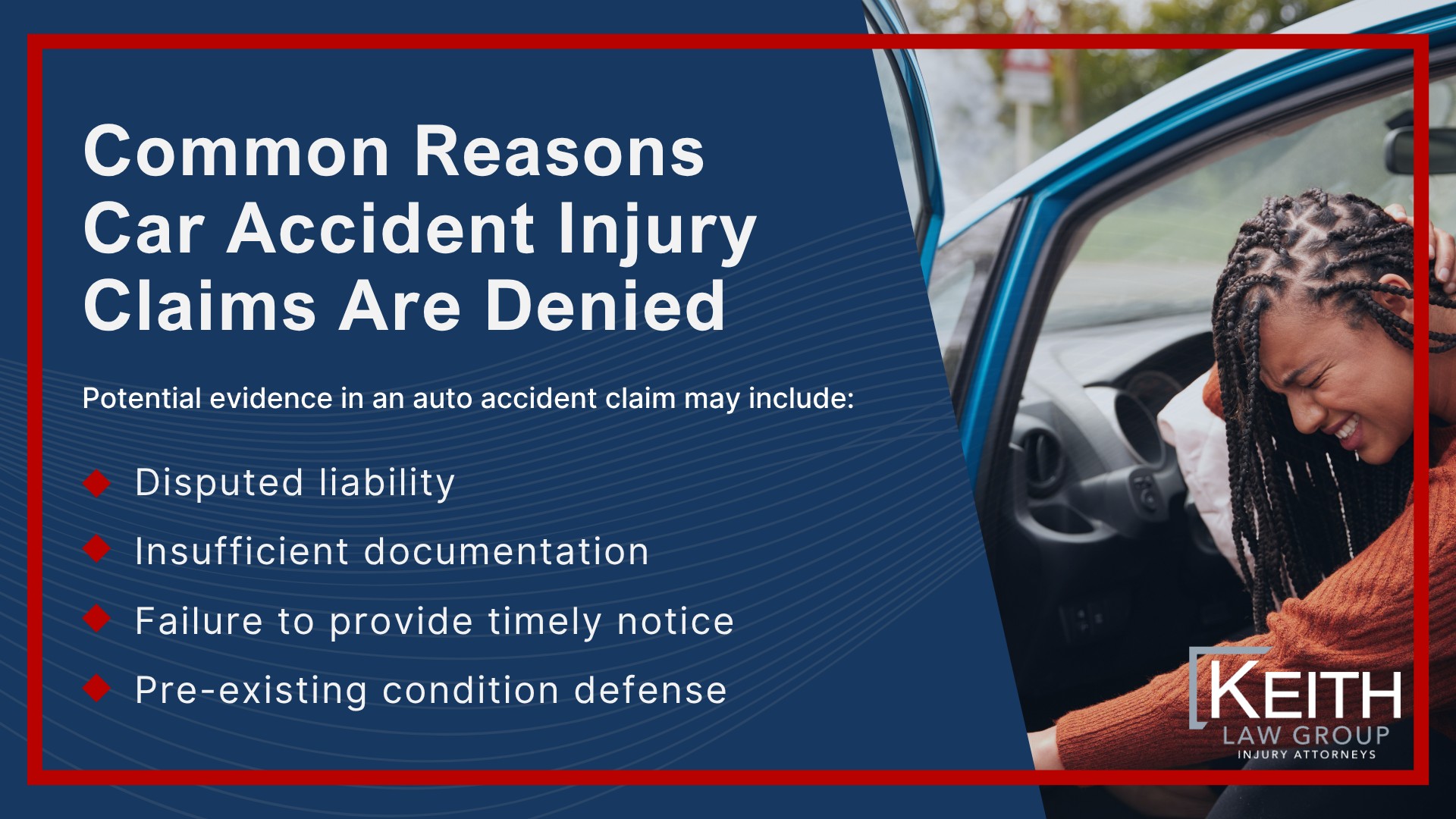
Common Reasons Car Accident Injury Claims Are Denied

Insurance companies deny personal injury claims based on specific grounds identified during claim review.

These grounds relate to liability, proof of injuries, and compliance with policy requirements.

The denial decision is tied to the position taken by the insurer on the available record.

Where the claim file does not support liability or damages, the insurer may refuse payment on that basis.

Reasons car accident claims are denied include:

  • Disputed liability: the insurer asserts that the claimant has not established that the other driver was primarily at fault under Ark. Code § 16-64-122, which may reduce or bar the ability to pursue compensation
  • Coverage limitations: the insurer takes the position that the claim does not fall within the scope of the policy or that the reported loss does not satisfy the conditions required for coverage
  • Insufficient documentation: the insurer determines that the medical records and supporting evidence do not adequately substantiate the injuries or the claimed damages
  • Failure to provide timely notice: the insurer relies on late reporting or incomplete notice as a basis to deny the claim under policy requirements
  • Pre-existing condition defense: the insurer attributes the injuries to a prior medical condition rather than the accident, particularly where the records do not clearly establish causation

Insurance companies may rely on more than one of these grounds when denying personal injury claims, especially where both liability and injuries are disputed.

How to Appeal a Denied Claim?

A denied car accident injury claim is appealed by responding to the reason the insurer gave for refusing payment.

The denial should be reviewed alongside the claim file, the medical records, and the policy language relied on by the insurer.

In practice, the appeal process involves correcting the issues identified in the denial and presenting the claim again with a complete and consistent record.

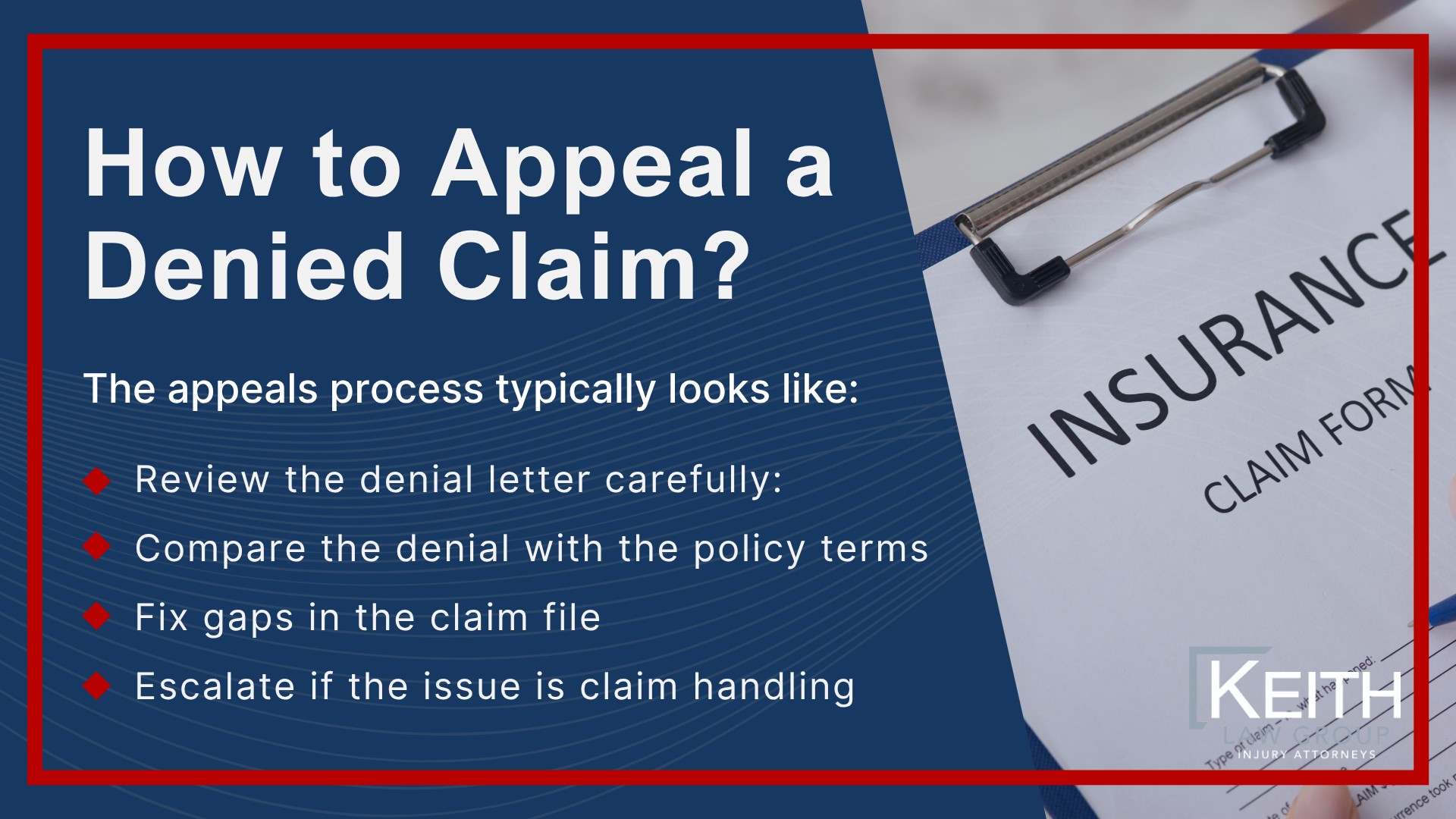
The appeals process typically looks like:

  • Review the denial letter carefully: Identify whether the denial is based on fault, lack of medical support, coverage limitations, or failure to meet policy conditions. The appeal must respond to that reason directly.
  • Compare the denial with the policy terms: Review the coverage provisions, exclusions, and notice requirements to determine whether the insurer’s position is supported by the policy.
  • Add the records that address the denial: If injuries are questioned, include medical records that connect treatment to the accident. If fault is disputed, include the accident report, photographs, or witness statements.
  • Fix gaps in the claim file: Missing records, inconsistent statements, or gaps in treatment can lead to denial. These issues should be resolved before the appeal is submitted.
  • Submit a written request for reconsideration: The appeal should explain why the denial should be changed and include supporting documents. It must follow the insurer’s internal review process and deadlines.
  • Escalate if the issue is claim handling: If the denial involves improper handling, a complaint may be filed with the Arkansas Insurance Department. This process reviews compliance with insurance rules but does not determine compensation.

Do You Need a Personal Injury Lawyer After an Arkansas Car Accident?

Personal injury claims in Arkansas are based on physical harm and the losses that follow.

A personal injury attorney can only help you if you suffered injuries as a result of your accident, as the claim must be supported by medical records and related damages.

Car accident claims in Arkansas are handled through insurance, but when injuries, fault, or coverage are disputed, legal representation becomes part of the claim process.

At that stage, how the claim is documented and presented begins to affect how it is evaluated.

Disputes over liability under Arkansas comparative fault rules, gaps in medical treatment, or questions about causation often arise during claim review.

These issues typically develop during the investigation and negotiation stages.

After initial medical treatment and claim reporting, many victims seek a free case evaluation or free case review with a personal injury lawyer to assess how the claim may be handled under Arkansas law.

At that stage, the available records are examined before the insurer finalizes its position on fault and damages.

An experienced personal injury attorney can help gather evidence and determine fault in a personal injury case, which is crucial for a successful claim.

As the claim progresses, communication with insurers and handling of documentation become central.

Where representation is involved, maintaining clients equal access to claim information and working to provide personal service can affect how responses are made and how the claim file is developed.

Having a lawyer by your side after a car accident ensures that long-term costs, such as lost wages and medical bills, are taken into consideration when negotiating with insurance companies.

In claims involving more serious injuries, the focus remains on presenting a consistent record that supports maximum compensation based on medical evidence and documented losses.

Contact Keith Law Group for Your Arkansas Car Accident Claim

A car accident injury claim in Arkansas starts with reporting and documentation, followed by insurer review of fault, medical records, and losses.

At that stage, the claim is evaluated against the accident report, treatment history, and supporting evidence to determine how liability and damages will be handled.

As the claim progresses, disputes often arise over fault allocation under Arkansas law and how the injuries are interpreted within the claim file.

Insurance companies rely on internal evaluation methods to assign value, and differences between that assessment and the claimed losses can prevent resolution at the insurance stage where injury victims seek compensation and financial recovery.

With nearly 47 years of combined experience, our firm handles personal injury claims through review, negotiation, and litigation where required, providing aggressive legal representation and working to fight tirelessly where the claim demands it.

Our attorneys work directly on the claim record, addressing how fault is presented, how medical records support the injuries, and how losses such as medical bills and lost wages are evaluated in personal injury cases involving disputed liability across our practice areas.

Contact today for a free consultation at (479) 326-7734, or check if you qualify to pursue your claim through our chat feature on this page.

Frequently Asked Questions

Published by:
Share

This article has been written and reviewed for legal accuracy and clarity by the team of writers and attorneys at Keith Law Group and is as accurate as possible. This content should not be taken as legal advice from an attorney. If you would like to learn more about our owner and experienced injury lawyer, Sean T. Keith, you can do so here.

Keith Law Group does everything possible to make sure the information in this article is up to date and accurate. If you need specific legal advice about your case, contact us. This article should not be taken as advice from an attorney.

Other Car Accident Lawsuit Resources
All
FAQs
Injuries & Conditions
Legal Help
Other Resources
Settlements & Compensation
You can learn more about other Car Accident Lawsuit resources below:
15 Common Car Accident Causes in Arkansas & Prevention Tips
Arkansas Auto Accidents: How to File a Car Insurance Claim
Arkansas Car Accident Compensation Types & Laws to Know
Arkansas Car Accident Lawsuit Guide: Tips for Success
Arkansas DUI Accident Lawsuits: Laws, Damages, & Safety Tips
Arkansas Hit and Run Accident Guide: Laws & Tips to Know
Average Arkansas Car Accident Settlements & Tips to Maximize Yours
Car Accident Damages in Arkansas: Potential Compensation
Car Accident Reporting in Arkansas
Car Accident Statute of Limitations Arkansas
Finding the Best Car Accident Attorney in Arkansas for Your Case
Hit and Run Car Accident Lawsuits in Arkansas
How Is Fault Determined in Arkansas Auto Wrecks?
How Much Can Someone Sue for a Car Accident in Arkansas
How Much Does a Car Accident Lawyer Cost to Hire in Arkansas?
How to File a Police Report After a Car Accident in Arkansas
How to File an Auto Accident Lawsuit in Arkansas
How to Get a Police Report After a Car Accident in Arkansas
Should I Get a Lawyer for a Car Accident?
Statute of Limitations: Car Accident Claims in Arkansas
Steps to Take After a Car Accident in Arkansas
T-Bone Car Accident Lawsuits in Arkansas: Things to Know
Types of Evidence in Arkansas Car Accident Cases
Understanding Car Accident Insurance Claims in Arkansas
Understanding the Arkansas Car Accident Settlement Process
Who Pays for My Medical Bills After a Car Accident in Arkansas

Other Car Accident Lawsuit Resources

All
FAQs
Legal Help
Other Resources
Settlements & Compensation